
IV — Industrial Revolution (1700 – 1945) · Chapter 20
Ford, the Moving Line, and the $5 Day
Mass production and the social contract that made it work
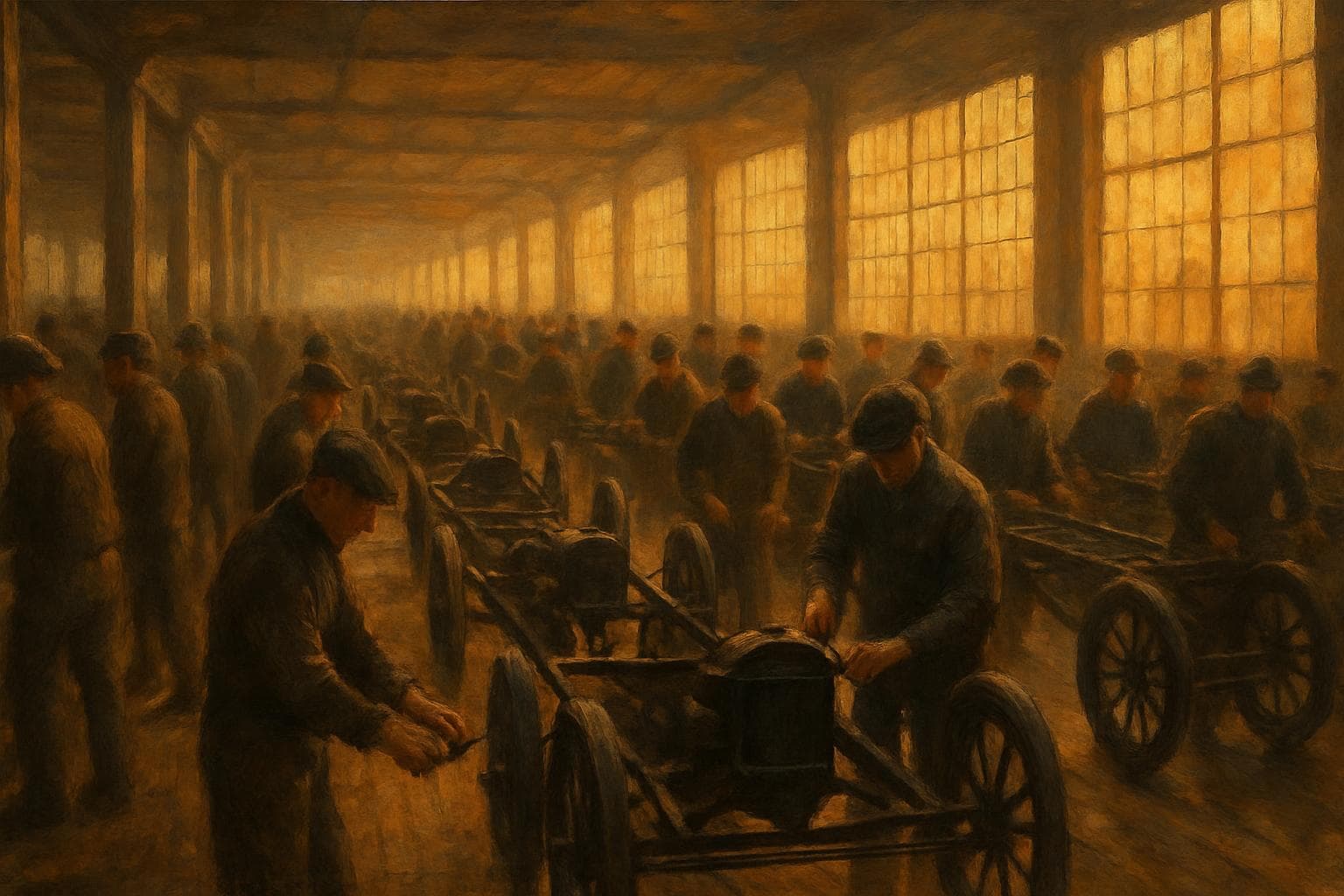
On October 7, 1913, the Highland Park plant of the Ford Motor Company in Detroit began assembling Model T automobiles on a moving line — chassis dragged past stationary workers by a chain conveyor, each worker performing one specific operation as the chassis passed. The change cut assembly time per vehicle from twelve and a half hours to ninety-three minutes. Three months later, on January 5, 1914, Henry Ford announced that his minimum wage would more than double overnight, from roughly $2.34 a day to $5 a day. Both decisions are part of the canonical story of American industrial management, and both are routinely misunderstood. The moving line was not Ford's invention. The $5 day was not philanthropy. Both were rational managerial responses to specific operational problems, and understanding why Ford did each of them, in the order he did, is more useful than the popular legend that has gathered around them.
What Ford Borrowed
The moving assembly line was not invented at Highland Park. Charles Sorensen and a small team of Ford engineers had been studying earlier moving-line installations for years. The most direct ancestors were the Chicago meatpacking plants, where carcasses moved past stationary butchers on overhead trolleys (the so-called 'disassembly line' that ran in reverse of what would become Ford's pattern), and the Singer Sewing Machine factory in New Jersey, which since the 1880s had used semi-automated production with interchangeable parts. Olds Motor Works in Detroit had used a stationary-line system since 1901 to produce the Curved Dash Olds. Ford's contribution was not the line itself but the integration of three specific innovations at unprecedented scale: a moving conveyor that paced the work, fully interchangeable parts manufactured to tight tolerances upstream, and the specialization of each worker to a single operation along the line.
The scale of integration is what made the breakthrough. Earlier moving lines were partial; earlier interchangeable-parts production was for small components; earlier worker specialization was uneven. Ford's engineers put all three together for the most complex consumer product ever mass-produced, and the productivity gain was vast. By 1914 Highland Park was producing more Model Ts per year than the rest of the world's automobile industry combined.
The Turnover Crisis
What is rarely emphasized in the popular story is how badly the moving line treated its workers. The pace was brutal. The work was mind-numbing. The supervision was authoritarian. The result, by 1913, was a labor turnover rate at Highland Park of approximately 370 percent. To maintain a workforce of 14,000, Ford had to hire roughly 53,000 men a year. The hiring and training costs alone were eating into the productivity gains the moving line had produced.
The $5 day, announced in January 1914, was the answer to this crisis. At $5 — more than double the prevailing Detroit wage — Ford could pick the best workers in the regional labor market, hold onto them, and reduce the turnover overhead. Within a year, turnover at Highland Park had fallen to about 16 percent. Hiring costs collapsed. The actual productivity of the workforce rose, both because the better-selected workers were more capable and because the workers who stayed accumulated experience on the line. The wage increase paid for itself within twelve months on retention savings alone, before counting the productivity gain.
Efficiency Wages, Three Decades Early
Modern labor economics has a name for what Ford did: the efficiency-wage hypothesis, formalized in the 1970s and 1980s by economists including George Akerlof, Janet Yellen, and Joseph Stiglitz. The hypothesis says, briefly, that paying above the market-clearing wage can be rational for an employer because the higher wage produces higher productivity through retention, selection, and motivation effects that exceed the wage premium. Ford had demonstrated the principle empirically sixty years before the academics formalized it.
The modern technology industry's compensation practices are a continuation of the same logic. Google, Facebook, and the major banks routinely pay their best engineers two to three times the median market rate, and the math works out for the same reasons it worked out for Ford. The cost of replacing a senior engineer who quits — recruiter fees, ramp-up time, knowledge loss, project disruption — is enormous, often exceeding the engineer's annual salary. Paying enough to keep them is, in efficiency-wage terms, a profitable investment. The popular framing of generous tech compensation as 'philanthropy' or 'extravagance' misses what Ford understood in 1914. It is retention math.
The Sociological Department
Ford's $5 day came with conditions that have aged less well. To qualify, workers had to satisfy the inspectors of Ford's so-called Sociological Department — a corps of investigators who visited workers' homes, interviewed family members, and certified that the worker was leading a 'wholesome' life. Drinking, gambling, taking in unmarried boarders, sending money home to relatives in Europe rather than spending it on the worker's American family — any of these could disqualify a worker from the higher wage.
The paternalism is the part of the Ford legacy that has aged worst. The Sociological Department was wound down in 1921 after several years of bad publicity, but its existence is a reminder that the early American corporate experiment with high wages came with substantial intrusion into workers' personal lives. Modern employer wellness programs, in their heaviest forms, are descendants of the same impulse — the company assumes a degree of moral oversight over the worker's off-duty conduct in exchange for the wage. The case for this is always made in terms of productivity. The case against, then and now, is that the company's authority over the worker's labor does not justify authority over the worker's life.
What Ford Got Right and Wrong
Ford got two things right that have shaped a century of management. First, integrated production at scale produces productivity gains that smaller-scale, less-coordinated production cannot match. Second, paying for retention is cheaper than paying for replacement, when retention is treated as a system-wide investment rather than an individual-line-item cost.
Ford got two things wrong that have also shaped a century of management. First, the dehumanization of work that the moving line produced was treated as a cost to be borne by the worker rather than as a problem to be solved at the design level — a debt that Lean production would eventually try to retire fifty years later. Second, the Sociological Department's paternalism contaminated the legitimate case for high wages with an illegitimate case for moral surveillance, a contamination that periodically resurfaces in modern corporate wellness programs and behavioral monitoring. The two halves of Ford's legacy are alive in every modern company. Adopting the productive parts and rejecting the paternalist parts is a managerial choice that each generation has to make explicitly.
The moving line and the $5 day are the two most-cited innovations in American industrial history, and the most caricatured. Ford did not invent the line; he integrated existing techniques at unprecedented scale. He did not pay the $5 day from generosity; he paid it from retention math. The two decisions were rational responses to operational problems that any large-scale modern enterprise faces in some form. The lessons are still operative. Production is structurally cheaper at scale, but only if the workforce can be kept; the workforce can be kept only by paying enough to keep them, in money and in conditions of work; and any moral apparatus that comes attached to the wage will contaminate the bargain in ways the company will eventually regret.
Sources
- 1.Ford Motor Company — assembly line · Wikipedia
- 2.Highland Park Ford Plant · Wikipedia
- 3.Ford's Five Dollar Day · Wikipedia
- 4.Efficiency wage hypothesis · Wikipedia
- 5.Ford's Sociological Department · Wikipedia
- 6.Charles Sorensen — Ford's production engineer · Wikipedia