
IV — Industrial Revolution (1700 – 1945) · Chapter 21
Mary Parker Follett and the Human Element
The management theorist most managers have never heard of
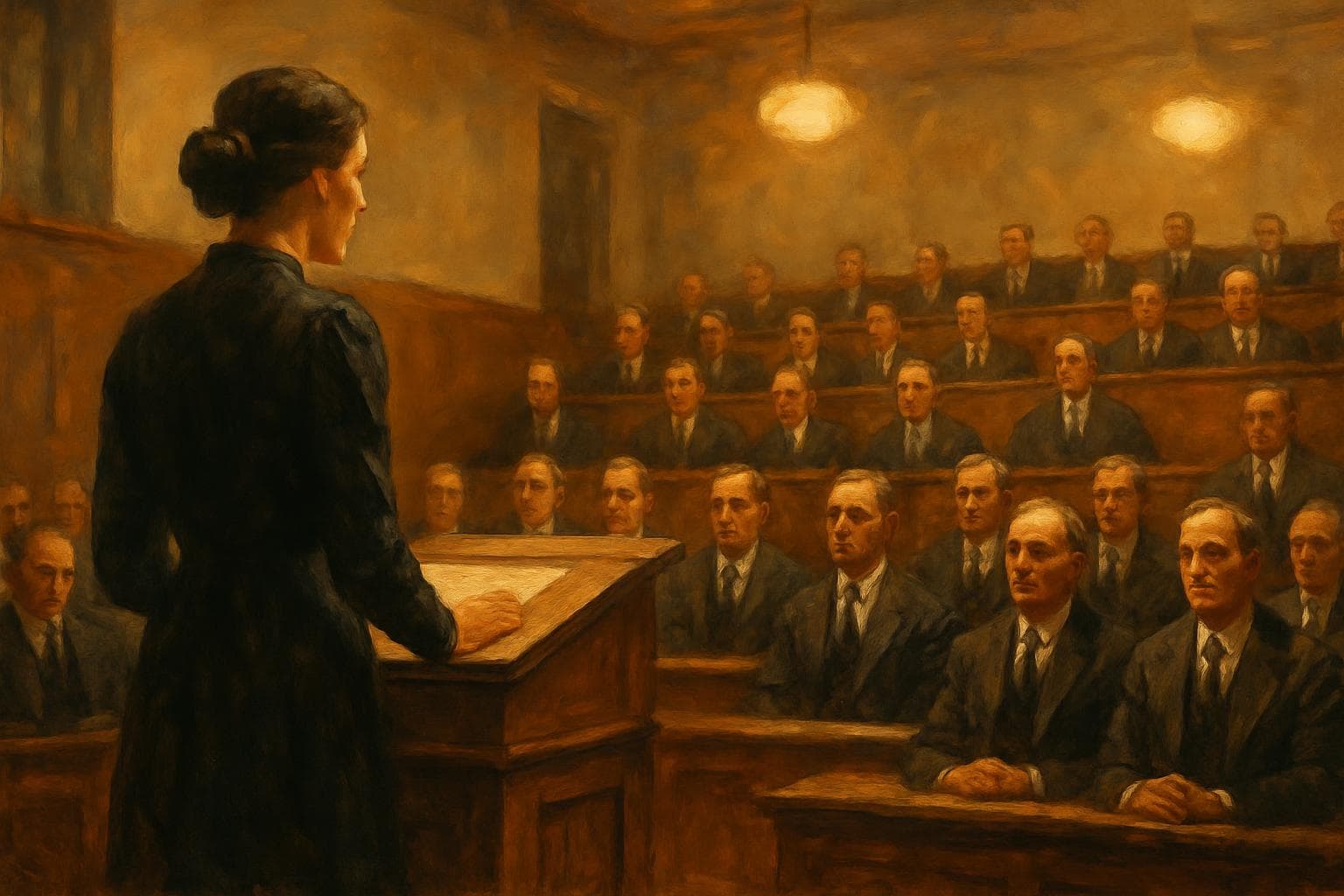
If you ask the average MBA student who shaped twentieth-century management thought, you will hear Drucker, Taylor, Deming, Mintzberg, Porter — and almost never Mary Parker Follett. This is one of the larger injustices in the canon. Follett was, by Drucker's own admission, one of the most important thinkers he ever read. Warren Bennis, the late leadership scholar, called her 'the most important woman who ever wrote on management.' Her work in the 1920s anticipated, by half a century or more, much of what we now teach as conflict resolution, integrative negotiation, servant leadership, situational authority, and constructive disagreement. She did this without a corporate career, without an academic appointment, and at a time when the field was so male-dominated that her own books were sometimes shelved under sociology rather than business. The job of this chapter is to give her the standing she has been quietly denied for the better part of a century.
Who She Was
Mary Parker Follett was born in 1868 in Quincy, Massachusetts, into an old New England family of modest means. She studied at the Society for the Collegiate Instruction of Women (the institution that became Radcliffe College), at Newnham College in Cambridge, and briefly in Paris. She was not academically credentialed in business — there was, in her early career, hardly any such credential to be had — and her first major work, The Speaker of the House of Representatives (1896), was a study of American political institutions.
What brought her to management was social work. From around 1900 onward, Follett spent two decades running a Boston-area network of vocational guidance centers, evening schools, and adult-education programs, primarily serving immigrant and working-class communities. The fieldwork — daily contact with workers, employers, ward bosses, school administrators, and union organizers — gave her the empirical foundation that her later management writing would draw on. By the 1920s she was lecturing to senior executives in New York, Boston, and Geneva on what she called the 'business problem' — how to organize human cooperation under conditions of disagreement.
Constructive Conflict
Follett's most lasting contribution is her theory of constructive conflict. Most thinking about conflict in her era — and frankly in ours — treated disagreement as a problem to be eliminated through suppression or compromise. Follett argued, against the grain, that conflict between people pursuing different legitimate interests is not pathological. It is the normal condition of any joint enterprise, and the manager's job is not to eliminate it but to use it productively.
She identified three responses to conflict: domination (one party imposes its will on the other), compromise (both parties give up something), and integration (a new solution is found that satisfies the underlying interests of both parties without either having to give up what they actually need). Domination produces resentment that compounds; compromise produces dissatisfied parties on both sides; only integration generates outcomes that all parties can defend. Follett's prescription — that managers should habitually seek integrative solutions — became the foundation, half a century later, of Roger Fisher and William Ury's Getting to Yes (1981) and the entire modern field of integrative negotiation. Fisher and Ury cite Follett by name; most of their readers have never followed up.
Power-With, Not Power-Over
Closely related to her theory of conflict was Follett's distinction between 'power-over' and 'power-with' — coercive authority that compels obedience versus collaborative authority that mobilizes joint capability. The 1920s was an era of titanic personal corporate authority — J. P. Morgan, John D. Rockefeller, Henry Ford — and Follett's argument that the most effective form of authority was structurally non-coercive was deeply heretical. She did not argue that authority itself was illegitimate; her writing is clear that organizations need decision-making authority. She argued that the source of effective authority was not the title or the boss's personal will but what she called the 'law of the situation' — the demands that the work itself made on those doing it.
The modern descendant of this idea is the concept of situational leadership, the recognition that the appropriate authority structure varies with the task being done. The further descendant is Robert Greenleaf's servant-leadership tradition, which makes Follett's 'power-with' the central virtue of leadership rather than a peripheral accommodation. The lineage from Follett to Greenleaf to the modern emphasis on psychological safety and team empowerment is direct, although the modern citations rarely make it back to Follett herself.
Why She Was Forgotten
Follett's eclipse from the canon has multiple causes. She died in 1933, before her ideas had the time to be institutionalized in business schools. Her writing was idea-dense rather than framework-dense, and the management literature of the postwar era favored writers (Drucker, Porter, Levitt) who produced cleaner, more transmissible frameworks. The fact that she was a woman in a field that became, by the 1950s, almost exclusively male did not help her posthumous reputation. And her substantive arguments — that conflict was productive, that authority should derive from the situation, that workers had legitimate co-authorship of their work — sat uncomfortably with the Taylorist and post-Taylorist mainstream that dominated American management thought through midcentury.
The rediscovery began slowly. Drucker mentioned her favorably from the 1950s onward. Warren Bennis pushed her case in the 1980s. Pauline Graham edited a collection of her papers in 1995, Mary Parker Follett: Prophet of Management, with appreciations by Drucker, Mintzberg, and Charles Handy. The contemporary feminist business-history literature has done substantial work to recover her standing. The result is that today's serious management curriculum is at least obliged to mention her, even if she is not yet quite restored to the seat in the canon she deserves.
What to Take From Follett
If you read Follett and take only one thing, take this: when you find yourself in a disagreement with a colleague, ask whether the conflict is being handled by domination (you or they will impose), compromise (both of you will give up something), or integration (you will find a third option that satisfies the underlying interests of both). Most workplace conflict, by default, drifts toward domination or compromise because both are easier to execute than integration. The discipline of pausing long enough to ask whether an integrative solution exists, and of looking honestly enough to find one when it does, is one of the highest-leverage habits a manager can develop.
The second thing to take is her account of authority. The boss's title gives them the power to compel; it does not give them the power to lead. Authority that is rooted in the requirements of the work — the law of the situation — is durable and legitimate; authority that is rooted only in title is fragile and resented. Modern managers who lean on title rather than situation discover this by failing slowly. Managers who lean on situation rather than title discover Follett.
Mary Parker Follett was right about more things, earlier, than almost any of her contemporaries, and she has been less famous than almost any of them. The discipline of management has been quietly poorer for the oversight. Read her — Creative Experience, the New State, the lectures collected as Dynamic Administration — and you will find a thinker whose frameworks have been quietly absorbed into the modern canon under other names. Restoring her name to those frameworks is a small piece of overdue intellectual housekeeping that this chapter is happy to perform.
Sources
- 1.Mary Parker Follett · Wikipedia
- 2.Creative Experience · Mary Parker Follett · 1924
- 3.The New State · Mary Parker Follett (Project Gutenberg) · 1918
- 4.Getting to Yes · Roger Fisher and William Ury · 1981
- 5.Robert Greenleaf — Servant Leadership · Wikipedia
- 6.Warren Bennis · Wikipedia