
IV — Industrial Revolution (1700 – 1945) · Chapter 19
Taylor's Scientific Management: The Best and Worst Idea of 1911
What he got right, what he got hauntingly wrong
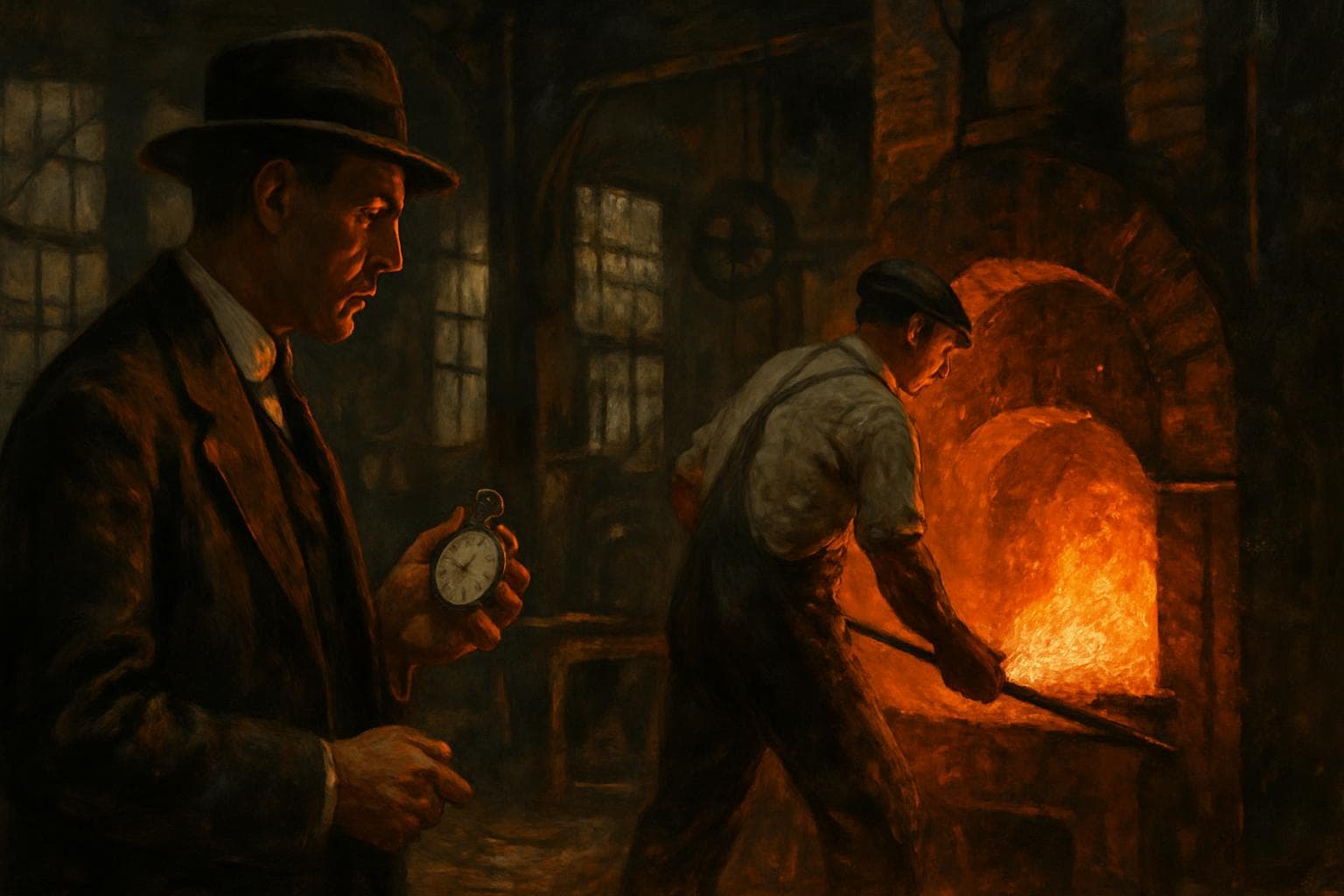
Frederick Winslow Taylor's 1911 book The Principles of Scientific Management is the single most influential and the single most controversial management text of the twentieth century. Peter Drucker called Taylor, alongside Darwin and Freud, one of the three thinkers who shaped the modern world. The labor historian Harry Braverman, writing in 1974, called Taylor's system the foundation of the dehumanization of industrial work. Both judgments are correct. Taylor invented the time-and-motion study, the standard work document, the explicit separation of planning from execution, and the entire vocabulary of industrial efficiency that the twentieth century lived inside. He also did so with a tone that ranged from condescending to actively contemptuous toward the workers whose movements he was systematizing, and the social damage from his system has taken a century to start undoing. He requires both a fair hearing and a fair indictment.
What Taylor Actually Did
Taylor began his career as a machinist at Midvale Steel in Pennsylvania in the 1880s. He noticed that the factory's machinists were not, in his terms, working at their full capacity. They had developed informal norms about reasonable output — what Taylor called 'soldiering' — that protected them from rate-cutting and from each other's competition. Taylor set out to determine, empirically, what the maximum achievable output of each operation was, and then to organize work so that it actually achieved that maximum.
His method was the time study. Stopwatch in hand, he observed each operation, decomposed it into elementary motions, timed each motion at a worker's best performance, and reconstructed an optimum process from the best individual elements. The result was a 'one best way' for each task, written down as a standard, taught as a procedure, and enforced as a target rate. The breakthrough was empirical — the standard rates were derived from measurement rather than negotiation — and the resulting throughput improvements at Midvale, then at Bethlehem Steel, were genuinely large. The pig-iron handling at Bethlehem, the example Taylor became famous for, went from a baseline of about twelve and a half tons per worker per day to forty-seven tons under his system. The numbers were not fabricated; the gain was real.
The Pig-Iron Story, Honestly
Taylor's account of the Bethlehem pig-iron experiment is the most-quoted single passage in The Principles of Scientific Management, and it deserves to be quoted honestly. Taylor describes selecting a worker — given the pseudonym 'Schmidt', actually a German-American immigrant named Henry Noll — for what he portrays as the worker's amenability to instruction. The book's depiction of the conversation between Taylor and Schmidt is contemptuous in a way that has aged badly. Taylor presents Schmidt as a man motivated entirely by money and incapable of understanding why he is being asked to lift pigs of iron in a particular sequence and at a particular pace.
The historical record is more complicated. Henry Noll was, by other accounts, a competent and self-respecting worker; the wage premium he was paid (about 60 percent above the standard rate) was real; the work was brutally hard, and Taylor's claim that 'eight out of ten' workers could not stand the pace is itself an admission. The experiment was a real productivity success and a real human failure at the same time, and Taylor's prose makes the failure worse than the experiment itself was. He could not write about the workers his system was reorganizing without condescension, and that fact has done as much damage to his reputation as anything in the system itself.
The 1911 Principles
The Principles of Scientific Management was Taylor's attempt to systematize what he had been doing in steel mills for two decades. The book's four principles, briefly: develop a science for each element of work; scientifically select and train workers; cooperate with workers to ensure work is done according to the science; divide work between management and workers, with management responsible for planning and workers for execution.
The fourth principle is the one that did the lasting damage. By prescribing a sharp division between thinking and doing, between planners and operators, Taylor systematized a separation that the medieval guilds and the Babbage tradition had treated as continuous. The worker was now to execute, not to invent; the engineer was now to plan, not to make. This division had two consequences. The first was a productivity boom — work done by specialized planners and specialized operators was, for many tasks, faster and more standardized. The second was a slow loss of operator knowledge: workers no longer expected to be the source of process improvement, the floor no longer expected to be heard, and the organization gradually forgot how to learn from its own production.
The Senate Hearings and the Backlash
By 1912, Taylor's system had become controversial enough that a special committee of the U.S. House of Representatives held hearings on its use in federal arsenals. The hearings were not friendly. Workers testified that the stopwatch and the standardized rate had broken their craft, intensified their pace beyond endurance, and stripped them of any voice in their own conditions. The labor unions of the period turned hard against Taylorism; in 1915 Congress prohibited its use, by name, in federal facilities — an extraordinary specific legislative rebuke.
The backlash was deserved and incomplete. The deserved part was the recognition that scientific management, as Taylor practiced it, treated workers as instruments rather than as colleagues. The incomplete part was that the productivity gains were real and the methodology of measurement and standardization was useful in itself, divorceable from Taylor's contempt. The next half-century of management thought was largely a project of recovering the methodology from the contempt — a project that would eventually succeed, more in Toyota City than in Pennsylvania, in the form of Lean production.
The Lean Recovery
The most consequential modern descendant of Taylor's measurement methodology is the Toyota Production System and its global descendants under the umbrella name Lean. TPS shares Taylor's commitment to the systematic study of work, the standardization of best practice, and the elimination of waste. It departs from Taylor on the question of who does the studying. In TPS, the operator is the principal author of process improvement; the andon cord lets any worker stop the line to flag a defect; suggestion systems generate millions of small improvements a year, originated by the people doing the work. The methodology is Taylorist; the social structure is Babbagian.
The contemporary fight over surveillance software in modern offices — the keystroke monitors, the screen-recorders, the productivity dashboards — is in essence a fight over which lineage of measurement we will inherit. Software that imposes external measurement on workers without giving them voice in the design or response is Taylorism revived in pixel form. Software that gives workers visibility into their own work, that helps them improve their own processes, that supplies the team rather than the surveillance team, is closer to Lean. Both options will continue to be available. Which one we choose, repeatedly, in product after product, will determine whether the next century repeats Taylor's mistakes or builds on Babbage's promise.
Taylor's place in the history of management is uncomfortable but unavoidable. He saw the productivity case for systematic measurement before most of his contemporaries did, and he was right that organizations that measured what they did would beat organizations that did not. He also pioneered a way of treating workers that left a hundred years of repair work in its wake. The modern manager who measures must keep both halves of his legacy in mind: the measurement is necessary, and the contempt is not. Get the first without the second and you are running a healthy operation. Get both and you are running a Bethlehem Steel pig yard, and your best people will leave.
Sources
- 1.The Principles of Scientific Management · Project Gutenberg · 1911
- 2.Frederick Winslow Taylor · Wikipedia
- 3.Scientific management · Wikipedia
- 4.Taylor's pig-iron experiment — historiography · Wikipedia
- 5.Lean manufacturing · Wikipedia
- 6.Toyota Production System · Wikipedia