
II — Ancient Roots (3000 BCE – 500 CE) · Chapter 6
Egypt: The Pyramid as a Project Plan
Twenty-year deliveries, paid in beer and bread
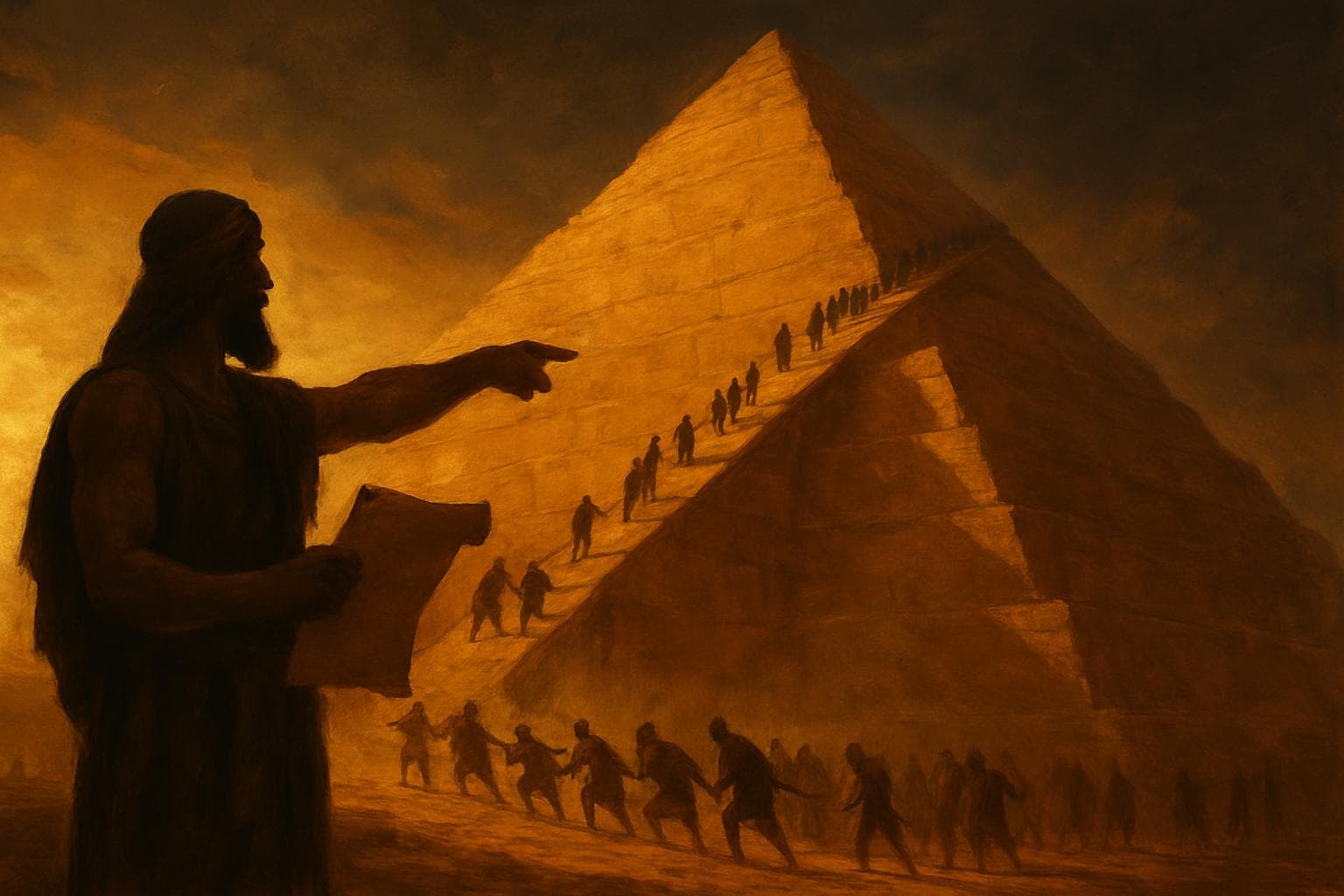
If you walk a modern construction site for a 200-storey skyscraper and then walk the desert plateau at Giza, you will recognize the second site faster than the first. The scale of the Great Pyramid — 2.3 million blocks, an average mass per block of around 2.5 tonnes, completed in roughly twenty years — is so far outside the comfortable range of small-team coordination that the entire project has the unmistakable signature of the modern delivery organization. The Egyptians did not invent management. But they ran a project of extraordinary scope, on a fixed deadline, against a remote desert site, with rotating labor, food logistics, river-borne supply chains, and a documented chain of command. They wrote the first project log we have in human history, and what it shows us — once you read past the romanticism — is professionalism.
The Slave Myth
For two centuries the dominant cultural image of pyramid construction was Charlton Heston's: a vast army of whip-driven slaves dragging stones across the sand. The image is wrong. Modern Egyptology — through the excavation of the worker villages at Giza by Mark Lehner and Zahi Hawass beginning in the 1990s, and the discovery of the Wadi al-Jarf papyri in 2013 — has produced a thoroughly different picture. The pyramids were built by rotating crews of paid Egyptian laborers, organized into named gangs, fed bread and beer at calorie levels documented in the bakery and brewery installations adjacent to their housing, and supplemented by skilled craftsmen on long-term contracts.
The quality of the workers' provisioning is itself the proof. The bone middens around the Giza workers' village contain the remains of hundreds of thousands of cattle, sheep, and goats — far more meat than slaves would have eaten. The skeletons show injuries, but also healed surgical interventions (set fractures, amputations, drilled cranial repairs) that no slave economy would have invested in. The pyramids were built by an organization that valued its workforce sufficiently to feed them well and treat them when they broke.
The Diary of Merer
In 2013, a French expedition under Pierre Tallet excavated a network of cave galleries on the Red Sea coast at a place called Wadi al-Jarf. Inside they found dozens of inscribed papyri — the oldest papyri ever recovered, dating to roughly 2560 BCE, the late reign of Pharaoh Khufu. One set, written by a mid-level inspector named Merer, is a daily logbook. It records, in a tidy professional hand, the activities of his team over several months in Year 27 of Khufu's reign: voyages to the limestone quarries at Tura, transit times up and down the Nile, deliveries of stone to the pyramid construction site at Giza, the names of his foremen, the rations issued to the men.
The Merer papyri are the oldest surviving project log in human history. The form is uncannily familiar to anyone who has run a modern construction or engineering operation. There are date stamps, work descriptions, names of subordinates, and audit-friendly tallies of what was moved and where. The administrative culture that produced this document was already, in the 26th century BCE, recognizably the culture of professional delivery management. There is a continuity from Merer to the modern site superintendent that two thousand years of slave-myth caricature has obscured.
Deir el-Medina: The First Documented Worker Strike
A thousand years later, on the west bank of the Nile across from Thebes, the Egyptian state ran a planned village called Deir el-Medina to house the craftsmen who decorated royal tombs in the Valley of the Kings. The village was occupied for roughly five hundred years. Its administrators kept records on ostraca — flakes of limestone used as scrap paper — and these have survived in unusual abundance.
The Deir el-Medina records read like an HR archive. Workers' attendance is logged day by day. Reasons for absence are recorded, often candidly: illness, family obligations, a sick wife, or — memorably — being 'with the brewer' or 'embalming father-in-law'. Disputes are arbitrated. Pay (in grain, fish, vegetables, beer) is allocated. And in Year 29 of Pharaoh Ramesses III, around 1157 BCE, the workers downed tools when their rations were late. The Turin strike papyrus records the event in detail: workers walked off the job, marched to the temple complex, sat down at the gate, and refused to leave until the bureaucracy delivered the grain owed to them. It is the first labor strike in recorded history, and it succeeded.
Crew Rotation as Schedule Management
Modern construction managers schedule labor in rotations because no human can maintain peak output indefinitely. The Egyptians appear to have known this. Herodotus reports — and modern evidence broadly supports — that pyramid labor was organized in three-month corvée rotations, with crews returning home to their farms during the agricultural season and serving on the pyramid project during the Nile flood, when the fields were under water. The matchup between the agricultural calendar and the construction calendar is unlikely to be coincidence; it is exactly the kind of resource-leveling decision a modern project manager would make. The construction site was the labor market's relief valve during the months when farming was idle.
This kind of rotation requires planning at a scale that is itself a managerial achievement. Provisioning enough food for tens of thousands of workers for the months they were on site, scheduling river transport of stone to coincide with the high water needed to float the heavy blocks, and rotating crews so that fresh teams replaced exhausted ones — all of this required a forecasting and logistics capability that the modern world reinvented several times in the centuries after the Egyptians let it lapse.
The Great Pyramid was the largest building on Earth for more than three thousand years. It was completed by an organization that wrote down what it did, fed its workers properly, planned its labor against the agricultural calendar, and tolerated a documented strike when it failed in its obligations. The romantic image of the cracking whip is a 19th-century European invention. The reality is closer to a modern industrial project — and unsettlingly competent.
Sources
- 1.Diary of Merer · Wikipedia
- 2.Wadi al-Jarf — Old Kingdom Red Sea harbor · Wikipedia
- 3.Deir el-Medina — workers' village · Wikipedia
- 4.Strike of the workers under Ramesses III · Wikipedia
- 5.Egyptian pyramid construction techniques · Wikipedia
- 6.Mark Lehner — Giza workers' village excavations · Wikipedia