
II — Ancient Roots (3000 BCE – 500 CE) · Chapter 5
Sumer and the Birth of the Ledger
How double-entry started in a temple granary
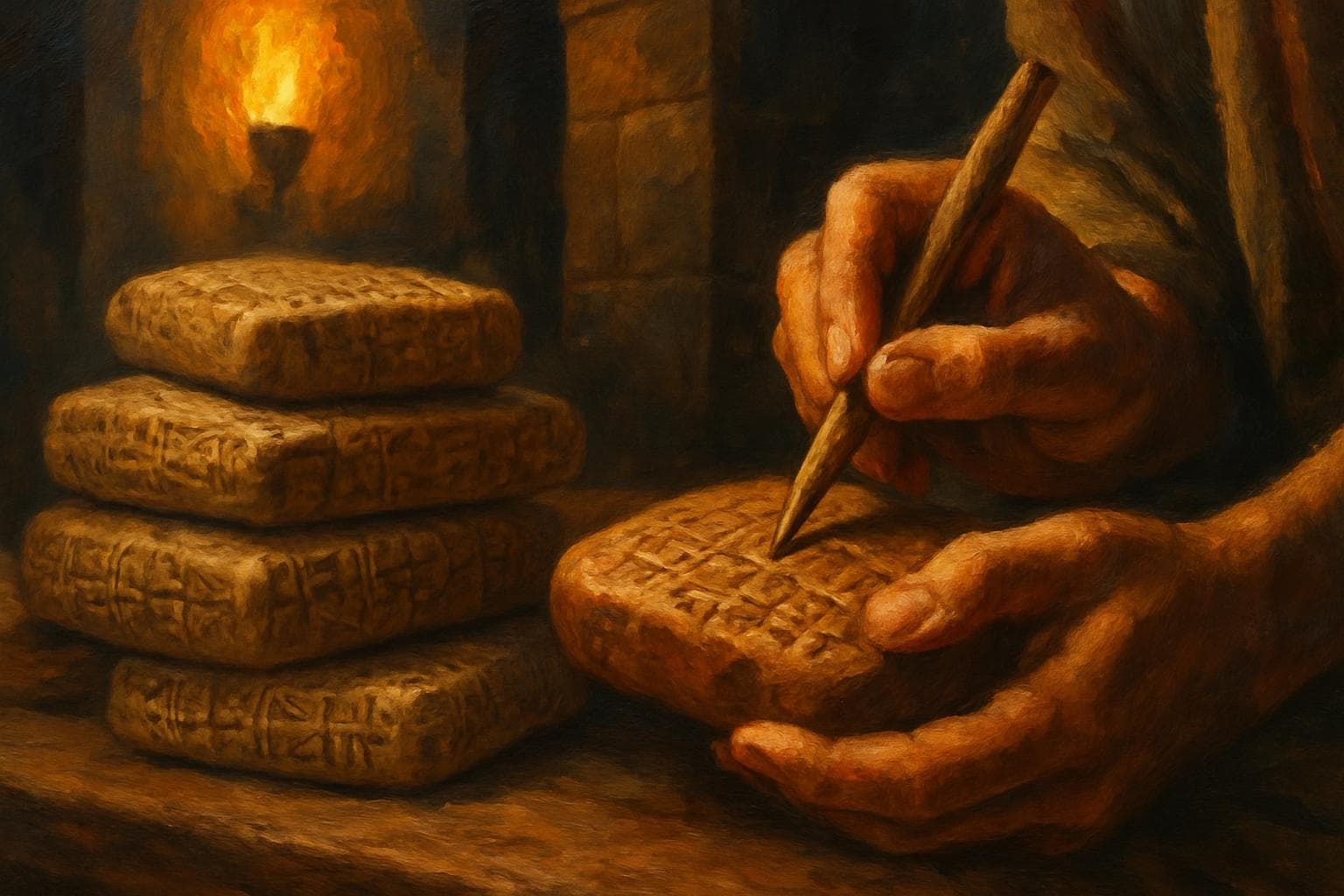
The story school children are taught is that writing was invented to record poetry, prayer, or law. It was not. The earliest writing on Earth, scratched into damp clay tablets in southern Mesopotamia between roughly 3300 and 3100 BCE, is in overwhelming proportion managerial. It records how much barley a man named Kushim received and from whom, how many days of labor were owed to a temple, how many measures of wool went to a particular weaver, how many sheep belonged to which estate. The literary masterpieces — the Epic of Gilgamesh, the great hymns to Inanna — appear centuries later, written in a script that had been invented for completely different reasons. Civilization started with a ledger.
From Tokens to Tablets
For at least four thousand years before cuneiform, the people of the Near East kept track of goods using small clay tokens — cones for measures of grain, spheres for jars of oil, disks for animals. The American archaeologist Denise Schmandt-Besserat traced the evolution of these tokens across the Neolithic, watching them grow more abstract and more standardized as economies grew. Around 3500 BCE, in the rising city of Uruk, accountants began sealing groups of tokens inside hollow clay envelopes (bullae) and pressing the shape of each enclosed token onto the envelope's surface as a manifest. Within a few centuries someone — we do not know who — realized the tokens themselves had become redundant. The impressions on the surface were the message.
This is the moment of writing. The first script — proto-cuneiform — is essentially a stylized rendering of the old token system, with a stylus replacing the press. The earliest tablets are not narratives but lists: counts and commodity signs, with names attached. Schmandt-Besserat's argument is that humans invented writing not to think but to count, and the cognitive expansion that came afterward — poetry, philosophy, law — was a side effect of a tool created to keep books.
The Ration Text
The dominant genre of the early Sumerian archive is the ration text. Cuneiform tablets from Lagash, Umma, and Ur record the daily, monthly, and annual issue of bread, beer, oil, and wool to named workers and their dependents. A typical document begins with a date formula, lists the names and titles of the recipients, gives the quantities, and ends with the seal of the issuing official. Some workers — like Kushim, whose name appears on roughly twenty tablets — show up so frequently that he has been called the first individual in human history known to us by name. He was an accountant.
The ration system was managerial in a deep sense. Allocation of food calibrated allocation of labor. Quantities varied by skill, age, and dependency status — a master craftsman received more than an apprentice; a woman with two children received a household ration; a child received a half-ration. The temple administrators were, in modern terms, running an HR department, a payroll system, and a benefits package, all of it documented in a way that another administrator could audit centuries later. The fact that we can still read the records is a feature, not an accident. Auditability was the point.
Why Recording Changes Everything
There is a hard ceiling on what can be coordinated by memory and oral instruction. A village can; a city cannot. The transition from village to city — the urban revolution of the late fourth millennium BCE — happened in lockstep with the transition from tokens to tablets, and almost certainly because of it. Once a coordination system can write things down, it can outlive any individual; it can be referenced rather than re-invented; it can be checked.
This is the reason the modern world's accounting standards are still, in their structure, recognizable to a Sumerian temple scribe. Double-entry bookkeeping, the great innovation of late-medieval Italy, is a refinement of the same idea: every transaction recorded twice, against two accounts, so that the books balance and any single error becomes visible. The 5,000-year-old observation underneath both is that trust at scale requires writing, and that writing imposes a discipline of structure on what would otherwise be remembered selectively.
The Audit Trail as a Management Technology
There is an unbroken thread from the Sumerian seal impression to the modern access log. The deepest reason organizations still keep audit trails is not regulatory; it is anthropological. Humans, individually, are unreliable narrators of what they did and why. The story we tell about our own past actions changes as our incentives change. Writing, signed and dated, is the only known countermeasure.
The Sumerians understood this. Tablets were often produced in duplicate — a working copy and a sealed archival copy — so that disputes could be settled by reference to a record neither party could rewrite. Modern source-control systems, with their immutable commit hashes, are doing the same job under different names. The mechanism keeps getting reinvented because the underlying problem keeps not going away: at scale, you cannot trust memory; you must trust the record.
If you take only one lesson from Sumer into your modern management practice, take this: write things down, make the writing auditable, and treat the record as the source of truth. Verbal commitments evaporate inside a week. Decisions made in conversations vanish from history within a quarter. The Sumerian temple administrator solved the problem in 3000 BCE by pressing reed stylus into wet clay. Your version is different — a ticketing system, a decision log, an architecture-decision record — but the act is the same, and the reason is the same.
Sources
- 1.Cuneiform — Origin and proto-cuneiform · Wikipedia
- 2.Denise Schmandt-Besserat — How Writing Came About · Wikipedia
- 3.Uruk and the rise of urban administration · Wikipedia
- 4.Kushim — earliest known named individual · Wikipedia
- 5.Double-entry bookkeeping — origins · Wikipedia