
II — Ancient Roots (3000 BCE – 500 CE) · Chapter 7
Sun Tzu: Strategy as Resource Management
Why The Art of War is mostly an operations manual
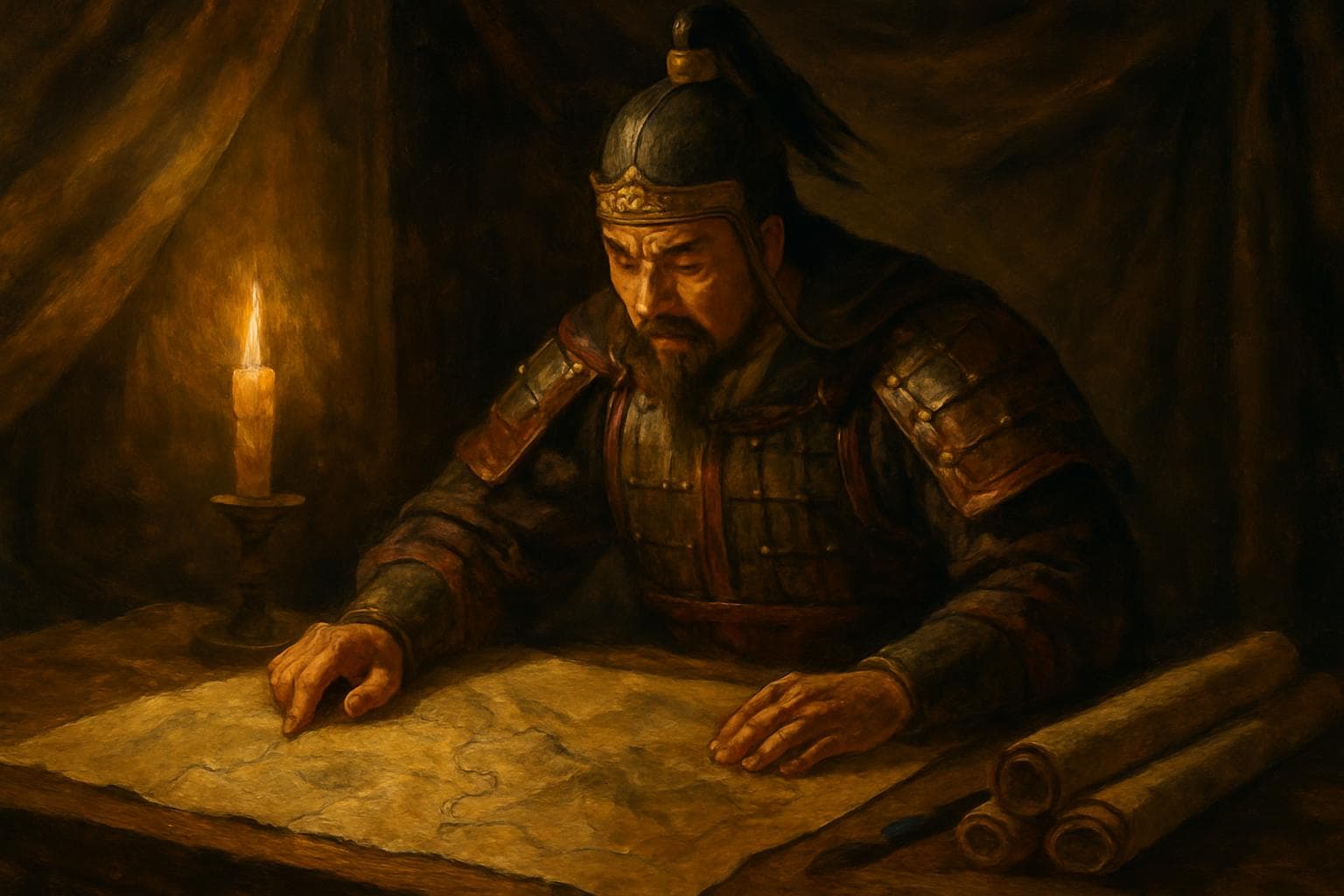
Sun Tzu's Art of War, composed in China during the Spring and Autumn or early Warring States period (somewhere between the 6th and 5th centuries BCE), is the most-quoted strategic text in human history. It is also the most thoroughly misread. The version that appears on dorm-room posters and in Wall Street paperbacks is full of cleverness about deception and surprise — an aphorism factory for ambitious people. The Sun Tzu his contemporaries actually read was something else: a sober, disciplined, almost accountant-like treatise on resource management under uncertainty. Strip the battlefield and what remains is an operations manual that any modern executive would recognize.
The Cost of Going to War, Counted
The second chapter of the Art of War is titled 'Waging War' (zuòzhàn), and it opens with an arithmetic exercise. Sun Tzu lists the cost of putting a hundred-thousand-man army into the field for a single thousand-li campaign: the chariots, the armor, the wagons, the silver, the food, the labor of guests and host states, the disruption to seven hundred thousand families behind the lines. The chapter then concludes — and this is the line everyone forgets — that 'no nation has ever benefited from prolonged warfare.' Sun Tzu's strategic genius starts with the assertion that war is ruinously expensive, and that the highest form of generalship is to win without fighting at all.
This is not pacifism. It is a finance argument. The whole structure of the book proceeds from the recognition that resources are finite, that every campaign is paid for in real consumption, and that a victorious general who has burned his economy has not won. Modern executives who quote Sun Tzu's chapters on 'attacking the enemy's strategy' without understanding that he opens with a P&L are reading him backward.
Logistics as Strategic Constraint
More than a third of the Art of War is, on close reading, about supply lines. Sun Tzu's persistent advice is to forage in the enemy's territory rather than ship from home — 'one cartload of the enemy's provisions is worth twenty of your own', he wrote, because the labor of moving food across a thousand li consumes nearly all of the food itself by the time it arrives. This is a transport-cost argument that any modern logistics planner would recognize immediately as a calculation of effective payload after fuel.
The broader principle is that a strategy whose logistics do not close cannot succeed regardless of the brilliance of its tactics. Sun Tzu makes this point with a clarity rarely matched in later strategic writing. Napoleon, two and a half millennia later, allegedly carried a translation of Sun Tzu and ignored its lesson; his Russia campaign collapsed because of exactly the supply-line dynamics the Art of War's second chapter warns about.
Chapter 13: The First Argument for Market Intelligence
The thirteenth and final chapter of the Art of War is on the use of spies. Sun Tzu identifies five types — local spies, inside spies, double spies, doomed spies, surviving spies — and argues that the cost of an entire military campaign is so vast that to conduct it without good intelligence is the false economy of all false economies. 'A man who is unwilling to spend a hundred ounces of silver in obtaining knowledge of the enemy's situation,' he writes, 'has no humanity.'
This is the first written argument for what we now call competitive intelligence, and the analogy to modern business runs deeper than the surface. Sun Tzu's spies are organized into a typology by access pattern, not by content. Inside spies are former enemy officials. Local spies are bribed civilians. Double spies are turned enemy operatives. The taxonomy is operational. Modern corporate intelligence, lawful or otherwise, runs essentially the same playbook with different tradecraft.
Boyd's OODA Loop as a Modern Translation
Colonel John Boyd, the U.S. Air Force fighter pilot and theorist, spent the second half of his career building what he called the OODA loop: Observe, Orient, Decide, Act. Boyd argued that the decisive variable in conflict — air-to-air combat, ground campaigns, business competition — is not the depth of the analysis but the speed of the loop. The side that cycles faster forces the slower side to fight against an outdated picture of reality.
Boyd was a careful student of Sun Tzu, and he acknowledged the lineage. Sun Tzu's emphasis on knowing both yourself and the enemy — 'know yourself and know your enemy and you will not be imperiled in a hundred battles' — is the same orientation step Boyd later formalized. The decisive contribution Sun Tzu makes is the insight that intelligence about your own organization is at least as valuable as intelligence about the competitor. Most strategic failures, then and now, are not failures of external analysis but failures to honestly perceive one's own state.
What Sun Tzu Said About Generalship
The Art of War's final irony is that the chapters most often quoted in business contexts — chapters on deception, on surprise, on flanking — are not the chapters Sun Tzu spent the most time on. The longest and most carefully argued sections concern the personal qualities of the general. Five virtues are required: wisdom, sincerity, benevolence, courage, and discipline. Sun Tzu treats these as load-bearing. A general who has the virtues but lacks the troops can still win. A general who has the troops but lacks the virtues will eventually lose.
This lands the Art of War squarely back in the territory of Chapter 4 of this book. Sun Tzu was, in the end, writing about the discipline of the self as the foundation of the discipline of the campaign. The reason his text has lasted twenty-five centuries is not the cleverness of his maxims about deception. It is that he placed the manager's character at the center of the model and refused to let any framework substitute for it.
The Art of War is a much quieter book than its reputation. Read it cover to cover and you find a sober operations manual whose principles — count the cost, mind your supply lines, invest heavily in intelligence, cultivate the virtues of the commander — are precisely those a careful modern executive would arrive at on their own. The text endures because it does not flatter. Pick it up if your strategic thinking is in trouble. You will not finish it feeling clever. You will finish it feeling more responsible.
Sources
- 1.The Art of War — Sun Tzu · Wikipedia
- 2.Sun Tzu — biography · Wikipedia
- 3.The Art of War (Lionel Giles translation, 1910) · Project Gutenberg
- 4.John Boyd — OODA loop · Wikipedia
- 5.OODA loop · Wikipedia