
III — Classical & Medieval (500 – 1700) · Chapter 16
The East India Company: The First Modern Corporation
How a chartered monopoly invented governance, badly
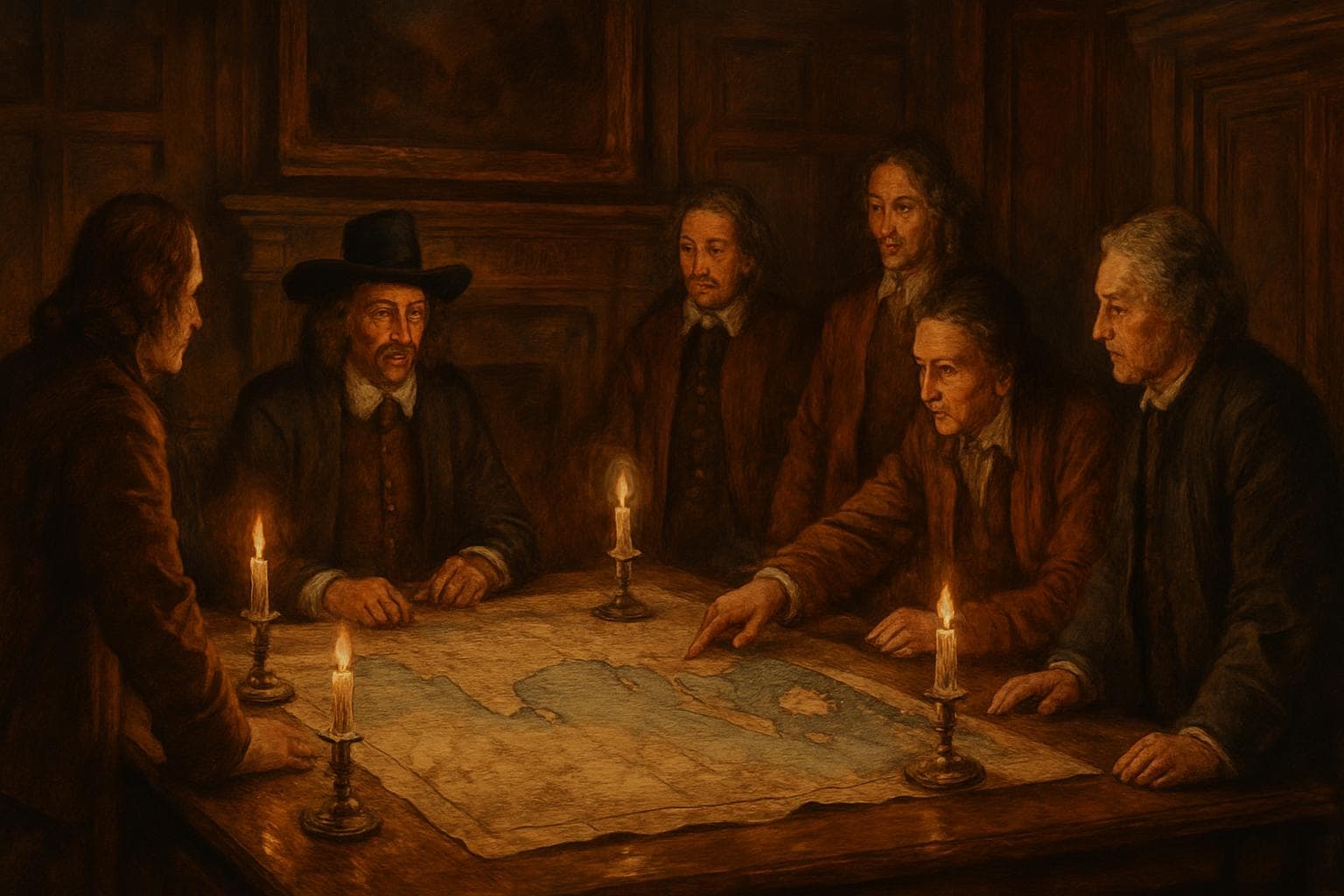
On the last day of the year 1600, Queen Elizabeth I signed a royal charter granting a group of London merchants a fifteen-year monopoly on English trade with the East Indies. The new entity was called The Governor and Company of Merchants of London Trading into the East Indies, but history would settle on a shorter name: the East India Company. Over the next two and a half centuries, this private commercial enterprise would invent or perfect almost every structural feature of the modern corporation — the joint-stock share, the board of directors, the shareholder meeting, the internal audit, the published annual accounts. It would also, along the way, run a private army of 260,000 soldiers, conquer most of South Asia, cause famines that killed millions, and provoke a regulatory backlash whose consequences are still working themselves out four centuries later. The EIC is the most important single institution in the prehistory of the modern corporation, and its lessons cut both ways.
The Joint-Stock Innovation
Before the EIC, English overseas trade was conducted on a voyage-by-voyage basis. Investors funded a single expedition, took the profit (or wrote off the loss) when the ship returned, and then negotiated a fresh syndicate for the next voyage. This worked tolerably well for short hops to the Baltic, but it was hopeless for trade routes to the East Indies, where a single round trip could take two or three years and the capital exposure was enormous.
The EIC's first major innovation, formalized after some experimentation in the early 1610s, was the permanent joint-stock structure. Investors purchased shares in the Company itself, not in individual voyages. The capital remained at work continuously; profits were distributed as dividends; shareholders could trade their shares to other investors without dissolving the syndicate. By 1657 the Company had moved to a fully permanent capital base, and the structural form that now underpins every public corporation in the modern world had been substantially worked out. The London Stock Exchange grew in part to facilitate the trading of EIC shares.
The Court of Directors: The First Board
The EIC was governed by an elected Court of Directors — twenty-four members, plus a Chairman, chosen annually by the shareholders at a General Court (i.e., shareholder meeting). The Court of Directors set policy, hired senior staff, oversaw the audit of the books, and reported to the shareholders at the next year's General Court. Beneath the Court sat a series of specialized committees — Correspondence, Treasury, Warehouses, Shipping, Buying — each chaired by a member of the Court and responsible for a functional area.
This is, in operational outline, the modern corporate board. The structure was sufficiently sound that it was copied — first by the Dutch East India Company (the VOC, founded 1602), then by the chartered companies that followed (the Hudson's Bay Company, the Royal African Company, the South Sea Company), and eventually by the joint-stock corporations of the industrial revolution. Modern American board governance, as codified in Sarbanes-Oxley and the NYSE listing standards, is a recognizable descendant of the EIC's Court of Directors.
Internal Audit and the Tyranny of Distance
Running an organization whose key operations were six months' sailing time from London required unusual rigor about internal records. The EIC's archives — held now at the British Library, where they fill several kilometers of shelving — are an extraordinary management document in their own right. Every voyage's manifest was logged in duplicate. Every consignment of goods was recorded against the contract that had specified it. Every advance to a country trader was signed for and audited at the next inspection. Servants of the Company filed quarterly reports from each of the major settlements — Madras, Bombay, Calcutta — and these reports were read, annotated, and acted upon by the Court of Directors in London.
The quality of this record-keeping was a competitive advantage. The Portuguese had been in Asian trade longer; the Dutch had more capital. The English, however, had a reporting and audit discipline that allowed London to detect fraud, misallocation, and mismanagement at a distance, and to act on it within reasonable timescales. This is the structural precursor of modern internal-audit functions, and the basic logic — independent, written, time-stamped reporting that bypasses local managers' incentives — has not changed.
Where the Model Failed
The EIC is also a cautionary tale, and the failures matter as much as the innovations. The first major failure was regulatory capture. By the 18th century the Company had become so politically powerful that the British state struggled to constrain it; Members of Parliament held EIC shares; senior Company officials sat in the Lords; the line between Company and Crown became blurred to the point of meaningless. The result was a private corporation conducting state-scale violence with limited public accountability — the conquest of Bengal, the Anglo-Mysore Wars, the famine of 1770 in which an estimated ten million people died while Company officials continued to extract grain revenue.
The second major failure was internal corruption. Despite the Company's audit machinery, individual servants — the so-called 'nabobs' — accumulated personal fortunes that dwarfed their official salaries through private trading, bribery, and outright extortion of local rulers. Robert Clive, one of the EIC's most successful military commanders, returned to England with a personal fortune of roughly £400,000 (perhaps £75 million in modern money), much of it acquired through means that even his contemporaries considered suspect. The audit system that worked at the institutional level failed to constrain the individual servant in the field, partly because the Court of Directors in London depended on those same servants for their information.
The Inheritance
Both halves of the EIC's legacy live on in the modern corporation. The structural innovations — joint stock, the board, the shareholder meeting, internal audit, published accounts — became the operating system of capitalism and remain so. The dysfunctions — externalities not borne by the corporation, regulatory capture, the principal-agent gap between distant headquarters and local operations — also became chronic features of corporate life and remain so.
The modern ESG movement, the various national equivalents of the U.S. Foreign Corrupt Practices Act, the disclosure regimes around supply-chain labor practices, the antitrust law that periodically constrains corporate scale: all of these are, in one way or another, attempts to manage the EIC-shaped problems that the EIC's structural innovations made possible. The corporation is a more powerful tool for human coordination than anything that preceded it. It is also a more powerful tool for human harm. Both are the EIC's bequest.
If you want to understand why the modern corporation looks the way it does — why there is a board, why there are quarterly reports, why there is an audit committee, why there is a chairman, and equally why there is also a body of regulation aimed at constraining all of this — the East India Company is the place to start. Most of what works was invented there. Most of what doesn't work has been discovered, painfully, in attempts to constrain what was invented there. The corporation is now four centuries old. Its instruction manual was written in London between 1600 and 1857.
Sources
- 1.East India Company · Wikipedia
- 2.Joint-stock company — historical origins · Wikipedia
- 3.Court of Directors of the East India Company · Wikipedia
- 4.Bengal famine of 1770 · Wikipedia
- 5.Robert Clive · Wikipedia
- 6.Regulating Act of 1773 · Wikipedia