
III — Classical & Medieval (500 – 1700) · Chapter 15
Machiavelli, Reread as a Manager's Manual
Beyond the bumper-sticker quotes
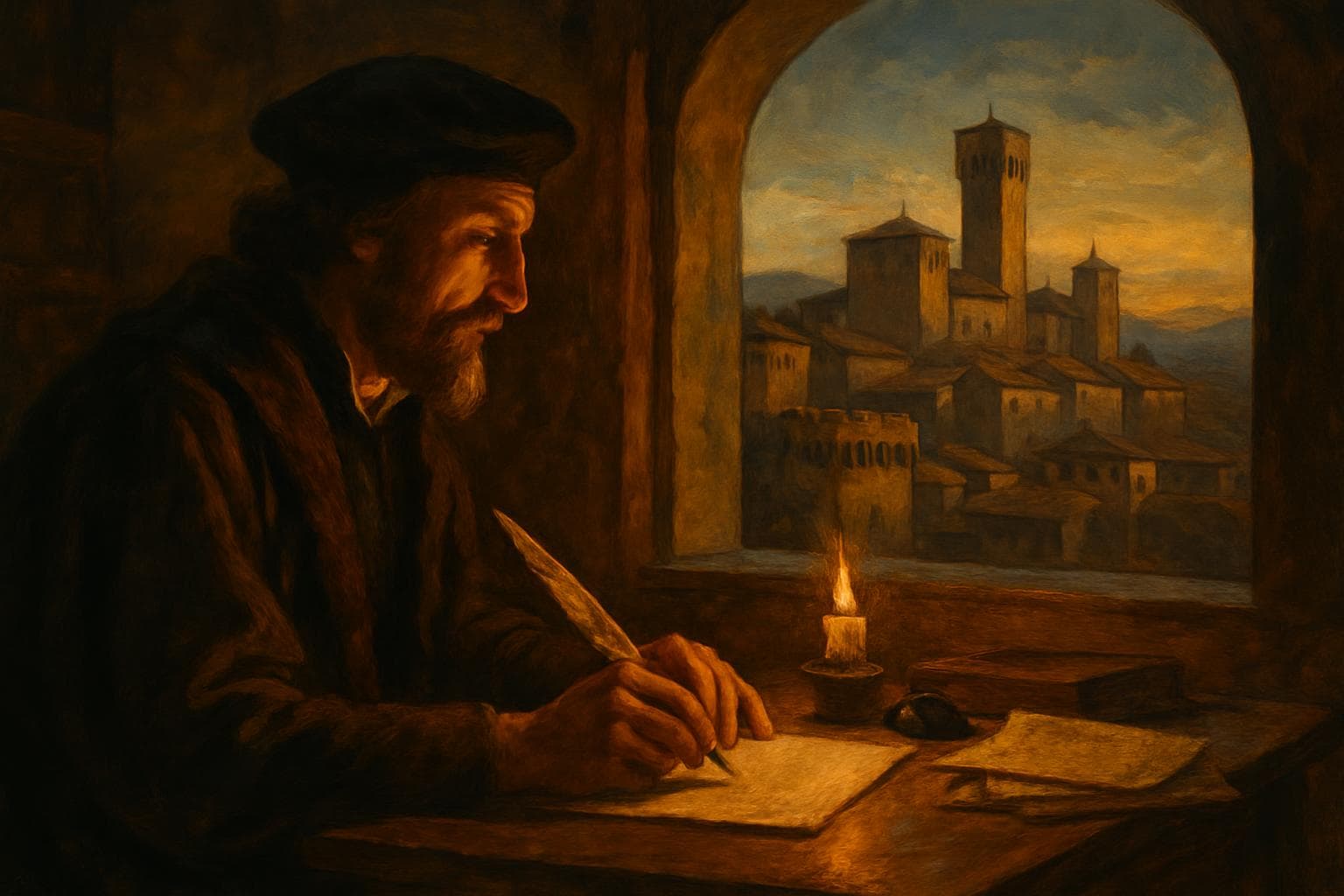
Niccolò Machiavelli has the worst public-relations record of any major thinker in the Western canon. He is the only one whose name became an adjective for villainy. The pop-cultural Machiavelli is a smirking, deceitful schemer; the philosophical Machiavelli is a cold systems-thinker; the Hollywood Machiavelli is the manipulative grand vizier. The historical Machiavelli was none of these. He was a working civil servant of the Florentine Republic for fourteen years, was tortured and exiled when the Medici returned to power in 1512, and wrote his books from a small farm at San Casciano while trying — without success — to get back into government. His two greatest works, The Prince and the Discourses on Livy, were the work of a senior practitioner who had been fired and was trying, painfully and honestly, to write down what he had learned. Read them as a manual rather than as a manifesto and they become startlingly useful.
The Two Books, Read Together
The Prince (composed 1513, published posthumously 1532) is the famous one — a slim, dense handbook on how to acquire, hold, and use power, addressed to Lorenzo II de' Medici as a job application. The Discourses on Livy (also composed in the 1510s) is the longer and more important book — a sustained meditation on the durability of republics, on why some institutions outlive their founders and others don't, and on the conditions under which distributed power produces better outcomes than concentrated power.
Reading either book in isolation is misleading. The Prince describes how to acquire and consolidate power; the Discourses describes how, once acquired, power can be made stable and beneficent only by republican institutions. Machiavelli was, on the evidence of the two books taken together, a republican. The Prince's grim advice on the use of force is the advice of a man who had watched his own city fall to a foreign army and had decided that political naivete kills as many people as cynicism. He wrote with no illusions, but his deeper sympathy was always with the institutions that allow ordinary citizens to live free of arbitrary rule.
Founded vs. Inherited Organizations
One of The Prince's most useful chapters distinguishes between principalities that are inherited and principalities that are newly founded. An inherited prince has the easier task; the institutions are in place, the population is accustomed to the family, the channels of power are familiar. A new prince has the harder task; he must create what an inherited prince merely receives. New princes who fail, Machiavelli argues, fail because they underestimate the work of building institutions and overestimate their own personal authority.
The modern parallel is exact. The founder of a new company has, in Machiavelli's terms, the harder task; the second- or third-generation CEO has the easier task in some respects (institutions exist) and the harder task in others (the institutions have already calcified). The CEO who succeeds an iconic founder — Tim Cook after Steve Jobs, Satya Nadella after Bill Gates, Sundar Pichai after Larry Page — is in a Machiavellian inherited-prince position. The work to be done is largely about adapting institutions whose original logic the inheritor did not write. The CEO of a newly founded company, by contrast, is doing the harder, riskier, more glamorous work of writing the institutions in the first place. The two roles require different temperaments. Machiavelli is one of the few writers who took the distinction seriously enough to teach it.
On Cruelty, Used Once
The most quoted (and most decontextualized) passage in The Prince is Chapter 8's discussion of cruelty. Machiavelli's actual argument is not 'be cruel.' His argument, given soberly and at length, is that necessary cruelties — the firings, the wars, the painful reorganizations — should be done all at once, decisively, early, and not repeated. Cruelties drawn out over time produce instability and resentment that exceeds the original problem. Cruelties applied early, decisively, and once allow the population to settle into the new arrangement and to remember the leader for the long subsequent peace rather than for the brief initial pain.
For a modern executive this translates directly. Layoffs that are necessary should be done once, in scale, and not repeated quarterly. Reorganizations that are necessary should be done at full depth and not in dribs. The temptation to soften painful change by dosing it gradually nearly always backfires; the organization remains in continuous low-grade distress, which compounds over time into something much worse than a single sharp shock would have been. This is a hard piece of advice and one that managers consistently get wrong. It is not advice to be cruel. It is advice that if cruelty cannot be avoided, the kindest form of it is decisive.
The Discourses: Why Republics Outlast Princes
The longer book argues, with unusual force for its era, that distributed institutions outperform concentrated authority over the long run. Princes die; their successors are mediocre; their dynasties decay. Republics, with their disagreements, their messy legislatures, and their slow processes, are more durable because they do not depend on the talent of any single person.
This is, in modern terms, an argument for institutional design over heroic leadership. The companies that outlast their founders — Procter & Gamble, IBM, Toyota, Berkshire Hathaway — have invariably done so by building institutional disciplines, succession pipelines, and decision-making structures that survive the loss of any individual. The companies that disappear with their founders did not. Machiavelli's claim, supported by his close reading of Roman history, is that the institutional work is the more important kind of work, even if it is less glamorous than founding. The Prince founds; the Discourses tells you what to do once founding is done.
Machiavelli on the Manager's Inner Life
What gets lost in the bumper-sticker reading of The Prince is its closing chapters, where Machiavelli writes about the personal qualities required of a leader. Virtù — usually translated as 'virtue' but closer in his usage to 'capacity' or 'excellence' — is the active, disciplined, intelligent quality that allows a leader to respond to fortune (fortuna, the unpredictable circumstances of the world). Fortune favors the bold, in his famous line, but boldness without virtù is just gambling.
This is the same argument made by the Stoics, the Confucians, and Drucker. The effective leader is not the lucky leader; the effective leader is the leader who has done the disciplined inner work to be able to respond to circumstance. Machiavelli's hardness, his realism about power, sits on top of an essentially classical conception of personal excellence. He is harder to dismiss as cynical when you read him with this in mind.
Read The Prince once and you will think Machiavelli is a cold operator. Read both books, twice, and you will conclude something different — that he was a senior practitioner who had been crushed by his own city's reversal, who tried in his quiet exile to write down what he had learned, and who wanted his country to be free under durable institutions rather than enslaved under either weak republicans or strong tyrants. This is not the Machiavelli of dorm-room posters. It is the Machiavelli most managers, eventually, find themselves needing.
Sources
- 1.The Prince · Project Gutenberg · 1532
- 2.Discourses on Livy · Project Gutenberg
- 3.Niccolò Machiavelli · Stanford Encyclopedia of Philosophy
- 4.The Prince — modern overview · Wikipedia
- 5.Discourses on Livy — overview · Wikipedia