
IV — Industrial Revolution (1700 – 1945) · Chapter 17
Adam Smith and the Pin Factory
Specialization as the original 10x
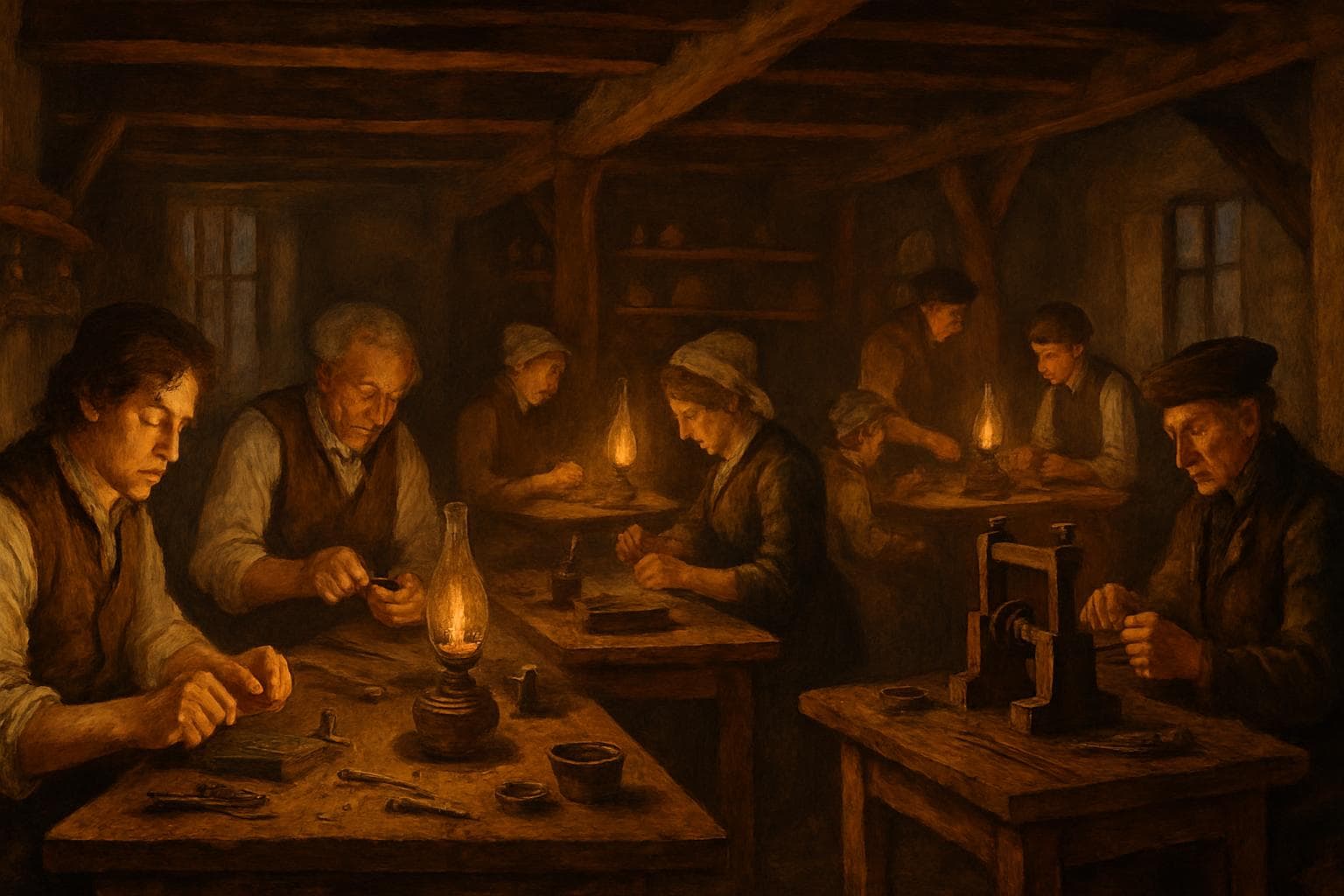
The first chapter of An Inquiry into the Nature and Causes of the Wealth of Nations, published by Adam Smith in 1776, opens with a description of a pin factory. Smith had not actually visited one — the example is borrowed from a 1755 article in the Encyclopédie of Diderot and d'Alembert — but he developed it into the most influential paragraph on productivity ever written. A single workman, attempting to make a pin alone, could perhaps produce twenty pins a day. Ten workmen, each performing one of eighteen distinct operations — drawing the wire, cutting it, sharpening one end, flattening the other for the head, and so on — could together produce 48,000 pins a day. Per worker, throughput rose roughly 240-fold. The observation became the founding text of industrial productivity theory, and it has been correct, embarrassingly correct, for two and a half centuries.
What Smith Actually Argued
The popular reading of the pin-factory passage treats it as a simple celebration of specialization. Smith's actual argument is more textured. He attributes the productivity gain to three distinct mechanisms. The first is the increased dexterity of each worker, who, repeating the same operation thousands of times a day, becomes faster and more skilful at it. The second is the saving of the time normally lost in switching between tasks — the worker no longer needs to put down one tool and pick up another, walk between stations, or reorient to a different operation. The third, and the one Smith found most interesting, is that workers focused on one operation are more likely to invent improvements to that operation: a better tool, a faster process, an automated cam.
The third mechanism is the seed of the industrial revolution. Smith's claim, articulated decades before any of the great mechanical inventions of the late 18th century, was that the division of labor would lead organically to mechanization. Workers concentrated on a single task would notice opportunities for machines to replace human hands, and over time the division of labor would call into existence the very tools that would amplify it further. This proved to be precisely what happened.
The Concern Smith Did Not Hide
Less remembered, but in the same book, is Smith's concern about the human cost of the system he was describing. In Book V of The Wealth of Nations he writes — and the passage is worth quoting at length — that 'the man whose whole life is spent in performing a few simple operations, of which the effects too are, perhaps, always the same, or very nearly the same, has no occasion to exert his understanding ... he generally becomes as stupid and ignorant as it is possible for a human creature to become.'
This is from the same author who introduced the productivity case for the division of labor in the same book. Smith was not unaware of what he was advocating; he was advocating a system whose efficiency he admired and whose human consequences he feared. His prescription was public education — the state should provide the schooling that the worker's specialized job no longer required of him. The two halves of Smith's argument have travelled badly through history. The productivity case is famous; the deskilling worry is largely forgotten. Reading both together is what serious engagement with Smith looks like.
Brooks's Counter-Theorem
Two centuries later, working on the IBM System/360 software project, Fred Brooks observed a phenomenon that complicates the pin-factory model. Some kinds of work do not divide neatly into independent operations. Software engineering, he argued in The Mythical Man-Month (1975), is a coordination-intensive activity in which adding people to a late project makes it later, because the cost of communication grows quadratically (n choose 2 new pairs) while the throughput grows only linearly. The pin factory worked because pins are independent. Software systems are not.
This is the counter-theorem to Smith. Division of labor produces the 240x productivity gain Smith described only when the work is decomposable, when each operation can be performed without continuous reference to the others, and when the throughput of the whole is the sum of the throughputs of the parts. When the work is genuinely interdependent — when each operation depends on the others' state — division of labor introduces coordination costs that can swamp the specialization gains. Knowing which kind of work you are organizing is the first managerial decision; everything else follows from getting that question right.
Microservices as the Modern Pin Factory
The contemporary software-architecture trend toward microservices — decomposing a monolithic application into many small, independently-deployed services with well-defined interfaces — is in significant respects a re-engineering of Smith's logic for digital work. Each service team specializes; each service has a clear contract; teams can iterate independently; productivity gains compound. The Conway-style team-API correspondence (a team's structure is reflected in the software it builds) is the modern echo of Smith's observation that organizational form follows from labor specialization.
The failure modes of microservices are equally Smith-flavored. When the service boundaries are wrong — when two services have to coordinate on every change — the coordination overhead exceeds the specialization gain, and Brooks's counter-theorem reasserts itself. When the workforce becomes deskilled because each engineer knows only their service and not the system as a whole, the deskilling concern Smith raised in Book V returns in modern form: an organization full of engineers, none of whom can reason about the architecture as a whole. Both problems are solvable; both require the manager to keep both halves of Smith's argument in mind.
What to Take From the Pin Factory
If you take only one operational lesson, take this. The first question to ask of any work is whether it decomposes — whether the parts are independent enough that specialists can work on them in parallel without continuous coordination. If they are, the pin-factory dynamics apply, and significant productivity gains are available through specialization, training, and eventually mechanization. If they are not, the work resembles software more than pins, and the manager's job is the harder one of designing coordination structures that keep the team's communication overhead within bounds.
The second lesson is to take Smith's deskilling concern seriously. Specialized work is more productive but less educational. An organization composed entirely of specialists will, over time, lose the capacity to reason about the whole. The countermeasure — Smith's own — is deliberate education, rotation, exposure across boundaries. The modern equivalent is investment in cross-functional development, formal training programs, and the slow, expensive work of producing engineers and managers who can think across the system rather than only within their slot.
Adam Smith's pin factory is the most influential factory that nobody has ever seen. The 240-fold productivity gain it described seeded two and a half centuries of industrial development and an enormous accumulation of human wealth. The deskilling concern Smith raised in the same book is the unfinished business of the same period. The careful reader of The Wealth of Nations comes away with both halves of the argument and the responsibility of holding them together. The careless reader walks away with a slogan about specialization and a lifetime of organizational mistakes ahead.
Sources
- 1.The Wealth of Nations · Project Gutenberg · 1776
- 2.Adam Smith · Stanford Encyclopedia of Philosophy
- 3.Division of labour · Wikipedia
- 4.The Mythical Man-Month · Wikipedia
- 5.Microservices · Wikipedia
- 6.Conway's Law · Wikipedia