
III — Classical & Medieval (500 – 1700) · Chapter 13
The Venetian Arsenal: Mass Production Before Industry
How Venice built a galley a day in the 1500s
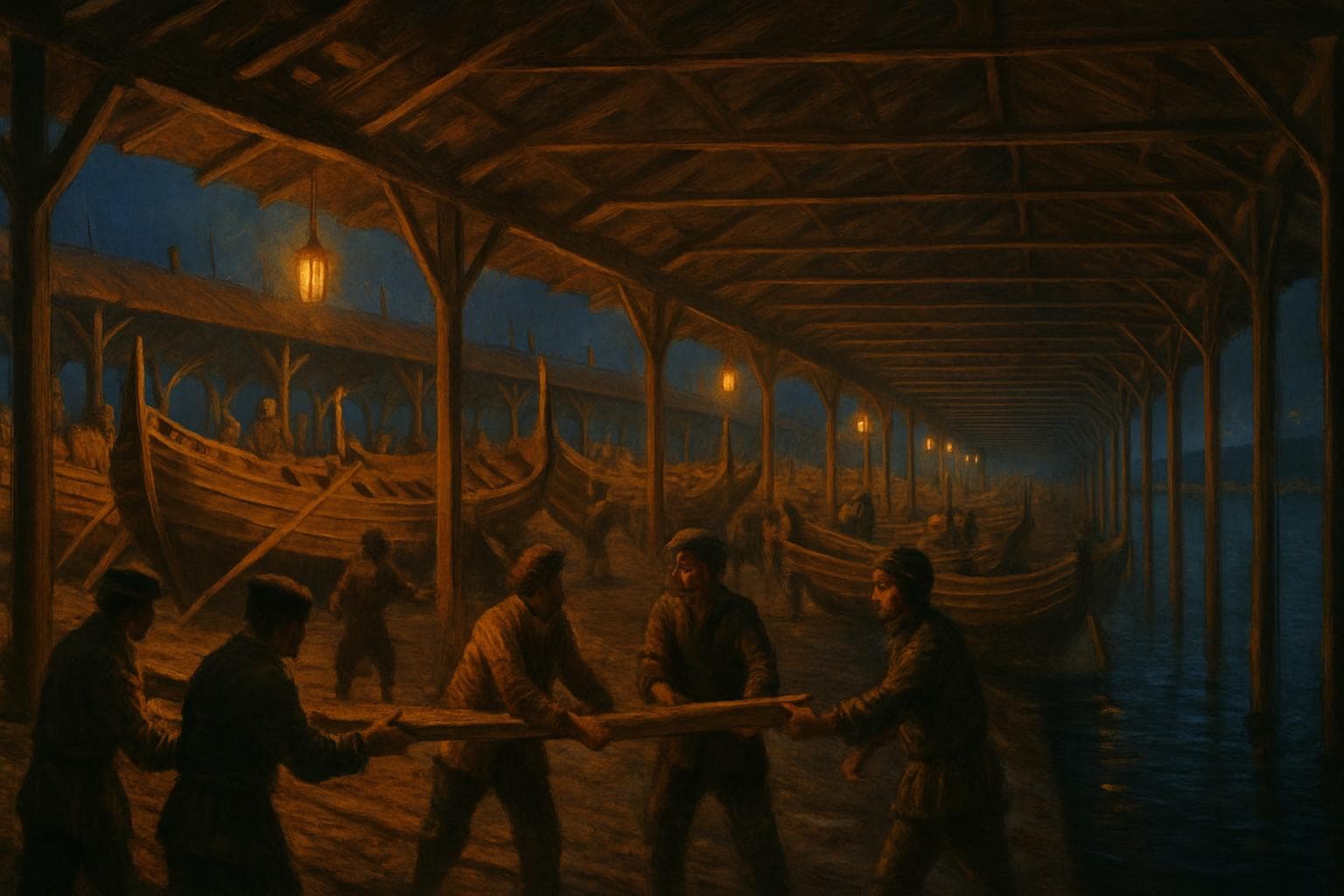
There is a popular story that Henry III of France, on his 1574 visit to Venice, was treated to an unusual banquet entertainment: as he sat down to dinner in the Arsenale, the keel of a war galley was laid; by the time he finished his meal, the galley sailed past the windows fully fitted, armed, and crewed. The story is probably embellished — most accounts put the construction time at closer to a day, not an evening — but the underlying capability was real. Two centuries before the Industrial Revolution and before Adam Smith ever wrote about pin factories, the Venetian Arsenale was operating the largest, most disciplined, most productive industrial enterprise in the European world. At its peak it employed 16,000 people in a single complex and was capable of producing a fully equipped war galley every day of a major mobilization. The mechanisms it used to do this are immediately recognizable to anyone who has read the Toyota Production System.
The Site
The Arsenale sat in the eastern half of Venice, a walled industrial city of roughly 110 acres at its eventual maximum extent — about a tenth the area of the entire historic core of Venice. It contained shipways, dry docks, foundries, ropewalks, sailmaking lofts, gunpowder mills, oar workshops, victualling stores, and the housing for the masters and their families. Material flowed into one end of the complex via canals; finished galleys flowed out the other. The whole site operated under the administrative supervision of the Provveditori all'Arsenal, three senior magistrates of the Venetian Republic.
What made the Arsenale exceptional was not size. Other navies built ships in dedicated facilities. What made it exceptional was vertical integration — every input to a war galley was produced inside the walls, to specifications set inside the walls, by workers managed inside the walls — and process discipline. Galleys were not built individually by master shipwrights working at their own pace. They were built by sequenced teams, each performing a defined operation, on hulls that flowed through the complex in a pattern that anticipated the modern moving assembly line by three and a half centuries.
Standardization of Parts
The Arsenale's most quietly revolutionary practice was the standardization of components. Galleys were designed to a small set of approved templates. The keel timbers, the planks, the oars, the sails, the cordage, the crossbows, the cannon mounts — all were produced in standardized dimensions, so that a part stored in a warehouse fit a hull built six months later. When a galley was damaged in battle, replacement parts could be drawn directly from inventory rather than custom-fitted on site. When a fleet was mobilized in emergency, partial hulls could be drawn from the Arsenale's stockpiles and finished in days.
This level of standardization required a different kind of management discipline than craft shipbuilding. The masters of each station had to certify that their output conformed to the template; quality inspectors verified at intervals; deviations were recorded and corrected. The system tolerated no individual artistic variation in the load-bearing parts of the ship. A free craftsman might have resented this; the arsenalotti — the Arsenale's hereditary workforce — accepted it because it was the price of the dignity, security, and high wages they enjoyed in return.
Takt and Flow
The 16th-century Arsenale operated on what Toyota would later call takt — a paced, synchronized flow of work through stations. A galley hull was towed from one fitting station to the next on a defined cadence. At each station, a specific operation was performed by a specific team: oars installed at this station, sails and rigging at the next, ordnance at the third, victualling at the fourth. The operations were synchronized so that no station was ever idle waiting for the previous station's output, and no station was ever overwhelmed by upstream production.
This is, structurally, the moving assembly line. Henry Ford's Highland Park plant, in 1913, would arrive at the same insight by way of meatpacking plants and Singer sewing machines. But the Venetians had it first, and ran it at scale, and produced an output rate during major mobilizations that the rest of Europe could not match. When the Ottoman fleet was destroyed at Lepanto in 1571, the Arsenale's ability to refit the surviving Christian fleet at speed was a meaningful element in the Holy League's continued naval superiority.
The Arsenalotti and Their Oath
The workforce of the Arsenale was organized as a hereditary guild — the arsenalotti — with its own privileges, its own pension system, and its own culture. Membership passed from father to son. The arsenalotti were exempted from many ordinary taxes, given priority for housing, and afforded a kind of citizenship below the patrician ranks but above the common population. They were also, structurally, the personal honor guard of the Doge during state ceremonies — a remarkable elevation for an industrial workforce.
In return, the arsenalotti swore an oath of quality that was operationally serious. Workmanship that failed inspection was punishable. The senior masters, the proti, served as quality gates and were themselves accountable to the Provveditori. The combination of pride of trade, hereditary continuity, and credible accountability produced a workforce stability that the Venetian Republic enjoyed for several centuries. Toyota's modern emphasis on the moral dignity of the production worker — the operator who can pull the andon cord, the suggestion box that takes worker input seriously — is a recognizable echo of this older tradition.
Why Venice and Why Then
Venice was a small city-state with imperial commitments. Her commercial and military supremacy depended on an oversized navy, and the navy depended on an industrial capability disproportionate to her population. The Arsenale was the strategic infrastructure that made Venetian power possible, and the Republic invested in it accordingly — capital, organizational attention, talent, and political prestige.
This is the durable lesson. Industrial capability of the Arsenale's caliber does not appear by accident. It is the product of a state (or, in modern terms, a company) that has decided manufacturing excellence is strategically essential and is willing to spend several generations of careful investment to build it. The decline of the Arsenale, slow but steady from the late 17th century onward, tracked Venice's broader strategic decline — once the Republic stopped needing a continental-scale navy, the institution that produced one began to atrophy. The lesson is the same one the modern American semiconductor industry is currently re-learning: industrial capability is not an entitlement; it is a discipline.
The Venetian Arsenale demonstrates that the Industrial Revolution did not invent industrial management. It invented the energy source — coal, then oil — that allowed industrial techniques to scale far beyond what hand labor and water power could support. The techniques themselves — standardization, sequenced production, takt time, in-line quality, integrated supply — were already mature in 16th-century Venice. Before there was Detroit, there was the Arsenale; before there was Toyota, there were the arsenalotti. The story of mass production is older, more European, and more cosmopolitan than its received history suggests.
Sources
- 1.Venetian Arsenal · Wikipedia
- 2.Arsenalotti · Wikipedia
- 3.Battle of Lepanto (1571) · Wikipedia
- 4.Republic of Venice · Wikipedia
- 5.Mass production — historical antecedents · Wikipedia
- 6.Toyota Production System · Wikipedia