
III — Classical & Medieval (500 – 1700) · Chapter 12
The Benedictine Rule and the Invention of the Workday
How a 6th-century monastery codified time and labor
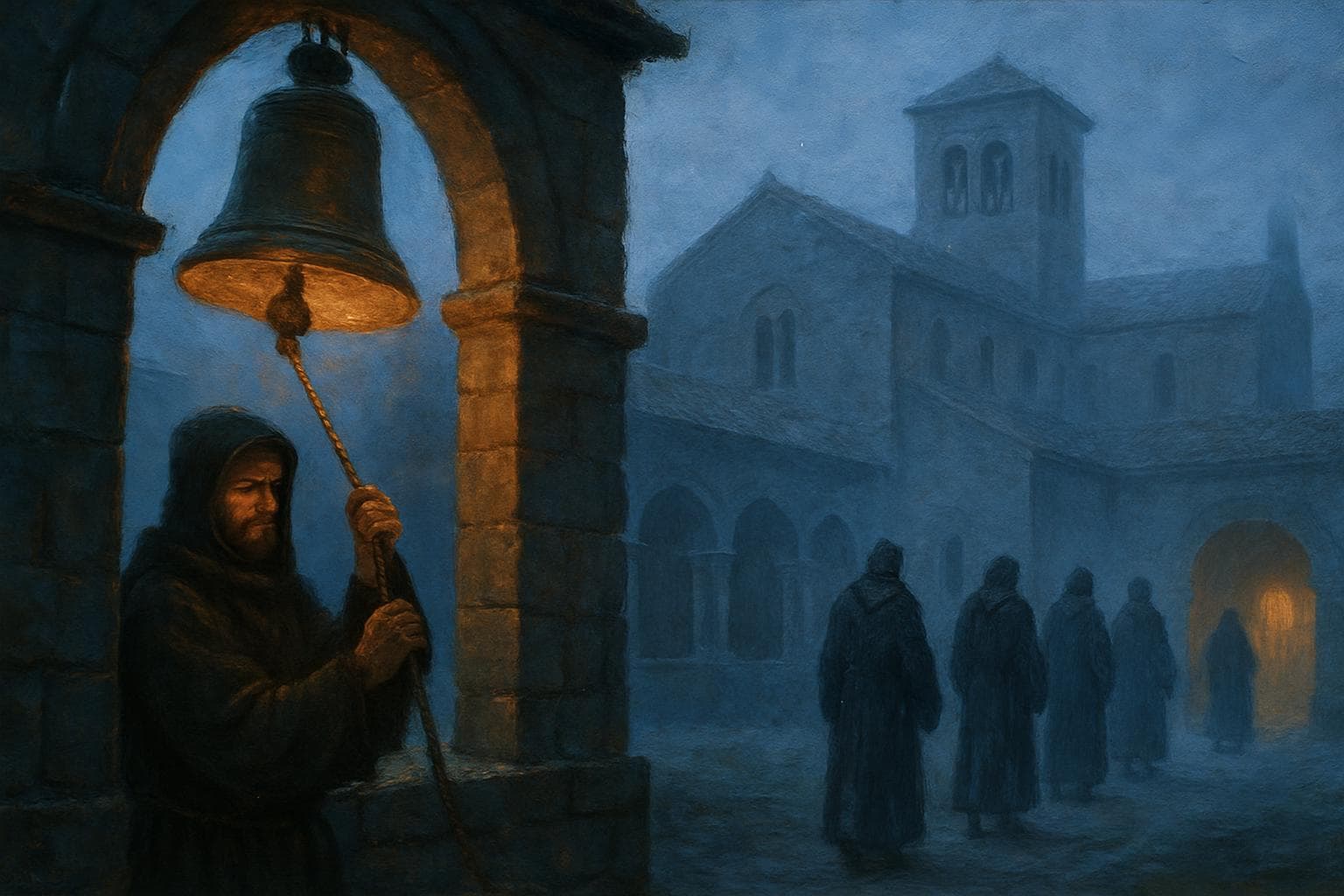
Around the year 530 CE, in a hilltop monastery at Monte Cassino, an Italian monk named Benedict of Nursia wrote a short, unornamented Latin handbook for organizing communal life. The Rule of Saint Benedict was not the first monastic rule, and Benedict was not a famous theologian. The text he produced, however, became the operating system of European monasticism for the next thousand years. By the high Middle Ages, perhaps half the population of Europe was, in some way, working under a calendar set by Benedict's eighty-six short chapters. The reason it spread is the same reason any management framework spreads: it worked. The Rule's contribution to the history of management is nothing less than the invention of the structured workday.
The Horarium: Time as Architecture
The Rule's most concrete contribution is the horarium — the daily schedule that governed every monk's hours from before dawn until after sundown. The monastic day was divided by the canonical 'hours' of prayer (matins, lauds, prime, terce, sext, none, vespers, compline), with discrete intervals for sleep, meals, manual labor (opus manuum), and sacred reading (lectio divina). The schedule shifted seasonally — different rhythms for summer and winter — but the architecture remained the same. Every hour of the day had a designated purpose. Every transition was signaled by a bell.
This was, for the sixth century, a startling discipline. Before the horarium, time in most of European life was elastic — set by daylight, by the agricultural calendar, by the demands of weather and visitor and accident. Inside the monastery, time became architecture. A monk did not decide when to pray, when to eat, when to read, when to work; the schedule decided, and the schedule was held in place by the bell. The result was a community that could coordinate the labor of dozens, then hundreds, of people on shared tasks — a level of coordination otherwise rarely achievable in the early medieval world.
Ora et Labora: The Reframing of Manual Work
The Latin tag attached to Benedictine spirituality — ora et labora, 'pray and work' — captures a substantive theological move. Manual labor in the late Roman world had been the domain of slaves and peasants, and the Mediterranean intellectual tradition (with the partial exception of certain Stoic strands) treated it as beneath the dignity of free men. Benedict's Rule placed manual labor on equal moral footing with prayer and study. Chapter 48, on daily manual labor, opens with the line: 'Idleness is the enemy of the soul; therefore the brothers should be occupied at certain times in manual labor and at other times in sacred reading.'
The consequence was unusual. A Benedictine abbot was responsible for fields, mills, granaries, breweries, vineyards, and craft workshops, and the labor was performed by educated men, often of noble birth, who had taken vows. The combination of literacy and physical work produced a civilization-changing effect: technical innovations were recorded, refined, and transmitted across centuries. Cistercian monasteries, a later branch of the Benedictine tradition, became the leading agricultural and metallurgical innovators of the high Middle Ages, in part because their organizational structure made systematic improvement possible.
The Bell as a Management Technology
The bell that summoned monks to each canonical hour was itself a piece of management infrastructure. Bells were precise enough that hundreds of monks across a large abbey could be coordinated within seconds. They were public — every brother heard the same signal at the same moment — which removed the need for individual instruction. They were authoritative, in the sense that the schedule was given by the bell rather than negotiated with each monk's preferences. And they were impersonal, which freed the abbot from being the daily embodiment of the schedule.
The transition from bells to mechanical clocks, beginning in the thirteenth century, was a continuation of this tradition. The earliest mechanical clocks were monastic — installed in abbeys and cathedrals to make the bell-ringing more reliable. The clock then escaped the cloister, spread to towns, and by the time of the industrial revolution had become the principal disciplinary technology of the factory whistle. Lewis Mumford, in Technics and Civilization (1934), argued that the clock, not the steam engine, was the key machine of industrial capitalism. He was right, and the lineage runs through Monte Cassino.
Cluny and Cîteaux: Variations on a Theme
Two later branches of the Benedictine tradition show how the Rule was operationally tuned. The Cluniac reform of the tenth century emphasized elaborate liturgy, lengthy chanting of the office, and the deferral of routine administrative decisions to the central abbot at Cluny — a centralized, ceremonial model. The Cistercian reform of the twelfth century pushed the opposite way, simplifying the liturgy, returning monks to manual labor in the fields, and operating individual abbeys with substantial local autonomy under a federated chapter structure.
Both were faithful to Benedict's Rule. They differed in operational style, much the way a heavily-process modern enterprise and a flatter, federation-style modern enterprise differ. The Cistercians produced more agricultural and technical innovation, partly because their decentralization allowed local abbeys to experiment. The Cluniacs produced more political and theological influence, partly because their centralization concentrated their voice. Neither model was right or wrong; the choice depended on what the order was trying to optimize for. The same calculus governs the modern federation-vs-centralization debate.
Why the Modern 9-to-5 Is a Monastic Inheritance
Most knowledge workers today still operate inside a calendar that is, in its bones, the Benedictine horarium. Wake at a fixed hour. Begin work at a fixed hour. Break for meals at fixed hours. End work at a fixed hour. The rhythm is so embedded in modern life that it appears natural; it is not. It is an institutional inheritance from a sixth-century Italian monastic rule, codified later by Bell Telephone factories, Henry Ford's assembly lines, and the contemporary office. The cubicle worker setting an alarm for 7:00 AM is, structurally, doing what a Benedictine novice did when the bell rang for matins.
The modern post-industrial argument that this schedule is obsolete — driven by remote work, asynchronous collaboration, and the realization that knowledge work has different rhythms than factory labor — is in part correct. But the underlying observation that humans coordinate better under shared rhythms is not new and is not going away. Companies that adopt fully asynchronous work tend, over time, to recreate Benedictine-style synchrony in subtler forms — daily standups, weekly all-hands, quarterly cycles. The horarium reasserts itself because the coordination problem it solves is real.
Benedict's Rule was not written to manage a corporation. It was written to make communal life possible for men who had renounced the ordinary measures of success. The fact that its mechanisms have shaped how the rest of us spend our hours, fifteen centuries later, is an unintended legacy that deserves more recognition than it gets. The next time the calendar tyrannizes you, remember: a sixth-century monk thought hard about how to free himself from idleness and accidentally invented the schedule that now organizes most of human work.
Sources
- 1.Rule of Saint Benedict · Wikipedia
- 2.Rule of Saint Benedict (full text) · Project Gutenberg
- 3.Liturgy of the Hours · Wikipedia
- 4.Benedictines — Cluniac and Cistercian reforms · Wikipedia
- 5.Lewis Mumford — Technics and Civilization · Wikipedia
- 6.History of timekeeping devices · Wikipedia