
I — Foundations · Chapter 3
The Manager as Craft, Not Title
Why the best managers think of themselves as practitioners
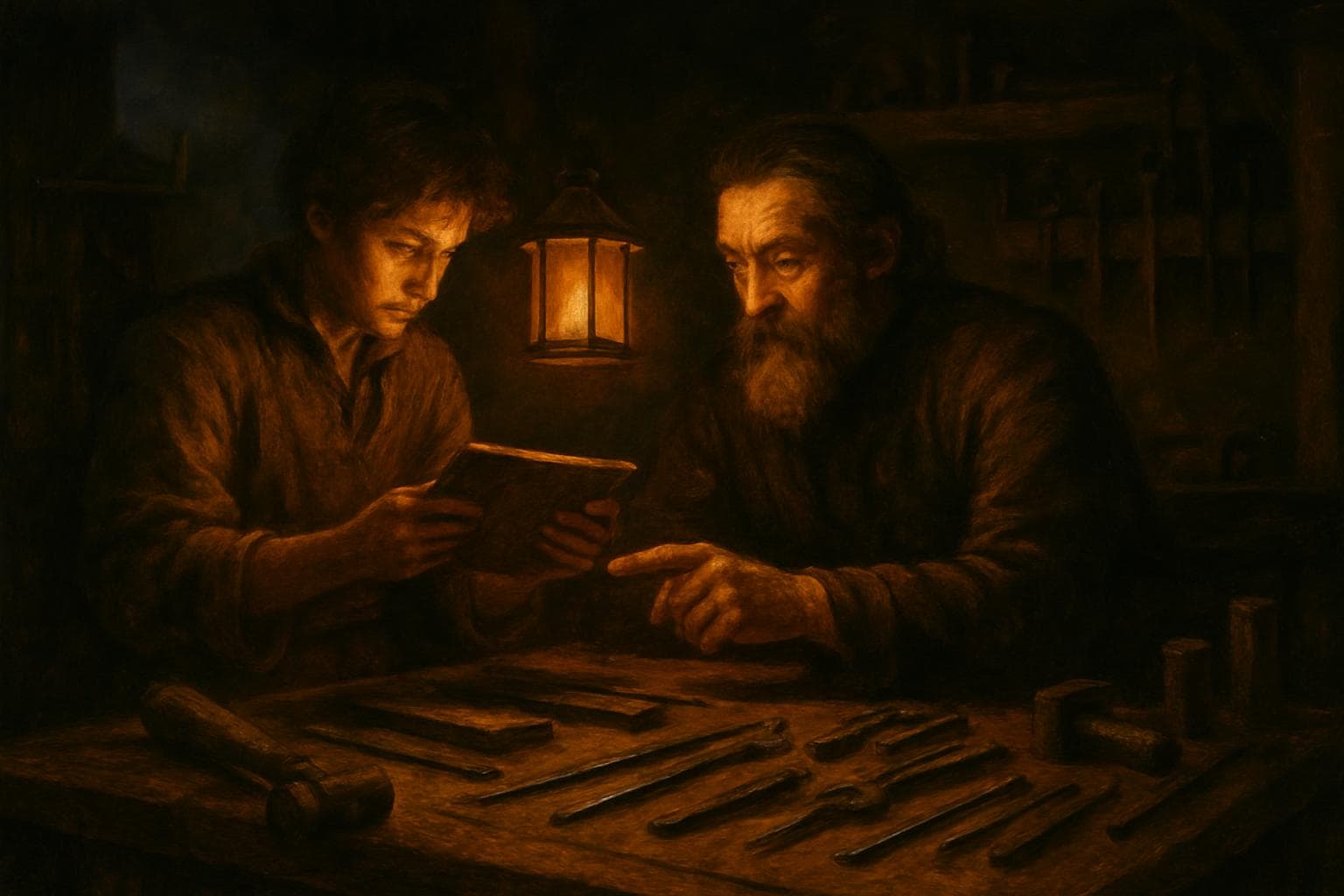
The modern career ladder presents management as a destination — a tier you cross into after enough years of individual contribution. The guild model that preceded it, and that produced craftsmanship of a quality the modern world struggles to match, treated mastery as something else entirely: a decade-long practice you submit yourself to, with intermediate stages that test your capability before they confer your title. The best managers in the modern world still treat their work this way, even when their organization treats it as a promotion. This chapter is about why the craft framing is the more honest one.
What the Guilds Got Right
The European craft guilds that organized urban production from roughly the 11th through the 18th centuries were many things — trade associations, political blocs, occasional cartels — but at their best they were pedagogical institutions. Their structure was a three-stage progression. An apprentice, typically a teenager, joined a master's household for seven years; he ate at the table, slept in the workshop, and learned by doing under daily correction. After his apprenticeship he became a journeyman (from the French journée, a day's work), traveled between cities on Wanderschaft, and worked for wages while broadening his exposure beyond a single master's idiosyncrasies. To make master and run his own shop, he had to produce a 'masterpiece' (Meisterstück) — a single object of sufficient quality to convince an examining committee of senior masters that he had crossed the line.
The seven-plus-three-plus-defense pattern was not arbitrary. It distributed learning across modalities — close mentorship, broad exposure, independent demonstration — and it tied the conferral of title to a falsifiable test. You did not become a master by being old enough or by your boss being pleased; you became a master by producing a thing that other masters could examine.
The Confucian Equivalent: The Junzi
On the other side of the Eurasian continent, Confucius described essentially the same arc, with different metaphors. The junzi — usually translated 'gentleman' or 'exemplary person' — was not born; he was made, by sustained practice in ritual (li), study (xue), and service. The Analects record Confucius cautioning that a man who has held office for forty years and not yet cultivated himself is unlikely to do so now. Mastery was assumed to require lifelong practice; the official position was a side effect, not the goal.
What the guild and the junzi traditions share is the assumption that competence is a thing you grow into, slowly, in public view. The certification follows the practice. This is a stark inversion of the modern path, in which the title often arrives first and the competence is expected to catch up later — sometimes successfully, often not.
Ericsson and the Modern Evidence
K. Anders Ericsson spent four decades studying expertise empirically. His central finding, summarized in his 1993 paper 'The Role of Deliberate Practice in the Acquisition of Expert Performance' and later popularized (and slightly distorted) by Malcolm Gladwell, is that elite performance in any domain — chess, music, sport, surgery — is the product of years of structured practice with three properties: it is hard, it is feedback-rich, and it is performed at the edge of one's current ability. Ericsson distinguished this from mere experience, which can plateau early and stay flat for decades.
Management is no exception. Twenty years of running staff meetings does not produce a great manager unless those twenty years included structured feedback, hard cases that stretched judgment, and reflection. This is why the most reliable predictor of a senior manager's quality is not their tenure or even their pedigree — it is whether they have been honestly coached at intervals throughout their career, and whether they sought out hard problems rather than coasting on familiar ones.
Andy Grove and the Modern Apprenticeship
Andy Grove's High Output Management (1983) is the closest thing the modern era has produced to a guild manual. Written by an Intel CEO who had personally trained generations of executives, the book treats management as a manufacturing process — inputs, throughput, output, leverage — and walks the reader through the daily mechanics: one-on-ones, staff meetings, decision-making frameworks, performance reviews, the discipline of deciding what not to do.
What marks the book as a craft manifesto is not its frameworks but its tone. Grove writes like a senior master walking a junior through the bench, occasionally stopping to demonstrate. He is not selling a method; he is showing his hands. The book has aged extremely well — read it cold today and it feels written last year — because the underlying practice has changed less than the surrounding noise suggests.
How to Treat Yourself Like an Apprentice
If you are managing today, the practical translation of all this is straightforward and uncomfortable.
First, find a master. Not a brand-name CEO; a working manager, ideally one rung above you, willing to read your written work and tell you why it is bad. The relationship is more valuable than any course you will ever pay for.
Second, broaden by Wanderschaft. Take a tour of duty in a function adjacent to your own — finance if you are an engineer, engineering if you are a marketer, operations if you are anything else. The journeyman year is not optional; it is what keeps you from the career-ending mistake of mistaking your function's view for the whole.
Third, produce masterpieces. At least once a year, do a piece of work — a strategy document, a launch, a turnaround, a hire — that you would defer to a panel of senior masters to judge. Ask them to. The willingness to put your work in front of people who can credibly humble you is, ultimately, the difference between a manager who keeps growing and one who has stopped.
Title inflation is the great occupational hazard of the modern manager. Every promotion makes the gap between what you are now called and what you have actually mastered slightly wider, and every quarter the gap closes only if you are deliberately closing it. The guildmasters had a word for someone who claimed mastery without earning it: pfuscher in German, botcher in English. There is no shortage of either in any era. The remedy has not changed since the 13th century. Submit yourself to a discipline. Find people who can credibly correct you. Produce work you are willing to have judged.
Sources
- 1.Guild — Apprenticeship and the masterpiece · Wikipedia
- 2.Apprenticeship · Wikipedia
- 3.Masterpiece · Wikipedia
- 4.Junzi (君子) in Confucian thought · Stanford Encyclopedia of Philosophy
- 5.K. Anders Ericsson — Deliberate practice · Wikipedia
- 6.High Output Management · Andrew S. Grove · 1983