
V — Modern (1945 – 2000) · Chapter 23
Deming, Toyota, and the Quality Revolution
How Japan rebuilt the world by counting more carefully
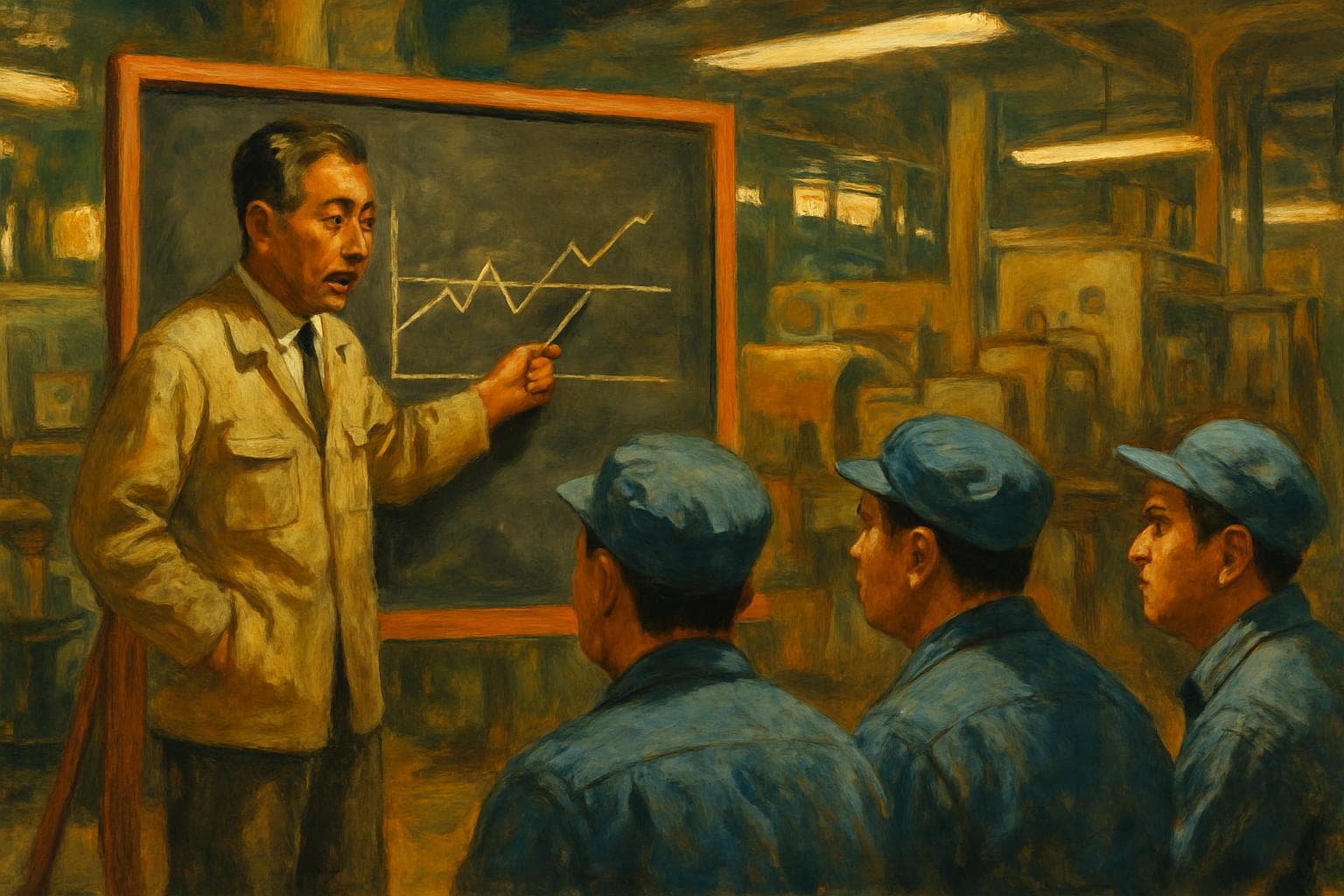
W. Edwards Deming spent the first half of his career as a prophet without honor in his own country. He was an American statistician trained at Yale and a wartime consultant to the U.S. Census Bureau and the War Department, applying statistical-process-control techniques to American war production. After the war he tried to convince American industry that the same methods would produce dramatic quality and productivity gains in peacetime. American industry, riding the postwar boom and unable to lose, was not interested. In 1950, the Japanese Union of Scientists and Engineers (JUSE) invited him to give a series of lectures in Tokyo. Japanese industry, ruined and rebuilding, listened. The result, over the next thirty years, was the systematic transformation of Japanese manufacturing into the global gold standard for quality, the near-collapse of the American automobile industry, and a permanent shift in how serious organizations think about quality and continuous improvement. The story is one of the largest cross-cultural transmissions of management thought in modern history.
Statistical Process Control: Where the Story Starts
The intellectual grandfather of Deming's work was Walter Shewhart, a physicist at Bell Labs in the 1920s and 1930s. Shewhart developed the control chart — a statistical tool for distinguishing between common-cause variation (the inherent variability of a stable process) and special-cause variation (signs that something specific has gone wrong) — and laid out the philosophical framework for what became statistical process control (SPC). Deming worked under Shewhart at Bell Labs and made his early reputation applying Shewhart's methods to wartime production.
The central insight of SPC is that processes vary, that the variation is measurable, and that responding to ordinary variation as if it were a special problem makes things worse rather than better. American managers in the immediate postwar period had a strong tendency to chase every defect as if it were a personal failing of the worker who produced it. Shewhart's mathematics showed that most variation came from the system, not the worker, and that improving the system was the only durable way to reduce defects. This was not a popular message at a time when American manufacturing was looking for individual scapegoats for quality problems. Japanese industry, with no time for that kind of luxury, took the message on board.
Deming in Japan
Deming's 1950 lectures to JUSE were attended by senior Japanese executives — including representatives from Toyota, Sony, NEC, and Mitsubishi — who took notes that they then carried back into their factories. Deming refused payment for the lectures. JUSE, in gratitude, established the Deming Prize in 1951, an annual award for the Japanese company that demonstrated the most significant achievement in quality management. The prize became, over the next forty years, the most coveted single recognition in Japanese industry; receiving it transformed careers and stock prices.
The content of Deming's teaching was not, on the surface, revolutionary. He taught Shewhart's control charts. He taught the discipline of identifying common-cause versus special-cause variation. He taught the importance of working on the system rather than blaming the workers. He taught what would later become the Plan-Do-Study-Act (PDSA) cycle of incremental improvement. None of it was secret; American manufacturers could have learned the same material at any number of universities. The difference was that Japanese executives took it seriously, applied it consistently for thirty years, and built it into the cultural foundation of their factories. Toyota's just-in-time production system, the kanban card, the andon cord that lets any worker stop the line, the institutionalized practice of kaizen — all are direct descendants of the methodology Deming brought.
The 14 Points
Deming's 1982 book Out of the Crisis distilled his thinking into a list of fourteen management principles. They have been quoted, paraphrased, and adapted countless times. A short selection: create constancy of purpose toward improvement of product and service; adopt the new philosophy (you can no longer live with the old levels of acceptable defects); cease dependence on inspection to achieve quality (build quality into the product in the first place); end the practice of awarding business on the basis of price tag alone; improve constantly and forever the system of production and service; institute training on the job; institute leadership; drive out fear; break down barriers between departments; eliminate slogans, exhortations, and targets that ask for perfection without giving the worker tools; eliminate quotas; remove barriers that rob workers of their right to pride of workmanship; institute a vigorous program of education and self-improvement; put everybody to work to accomplish the transformation.
What is striking about the list, decades after it was written, is how much of it is still being learned. The injunction against driving out fear; the case against rate-based quotas; the argument that quality cannot be inspected in but must be built in; the insistence that workers should have pride in their work — these remain, sixty years on, the unfinished agenda of most American organizations. Deming did not name new sins. He named old ones with unusual clarity, and he insisted, against the management fashion of his time, that they would only be solved by changing the system rather than blaming the people inside it.
The PDSA Cycle
Deming's most operationally useful contribution may be the Plan-Do-Study-Act cycle (originally Plan-Do-Check-Act, modified by Deming himself in his later writing). The cycle is simple: plan a change you believe will improve a process; do (i.e., implement) the change at small scale; study the results to see whether the improvement actually occurred; act on what you learned (adopt, abandon, or revise the change). Then begin again.
This is, in modern terms, the experiment-driven approach to organizational improvement. The PDSA cycle is the ancestor of A/B testing in software product development, of agile retrospectives, of the build-measure-learn loop in lean startup methodology, and of the continuous-deployment practice in modern engineering. Each of these is a domain-specific re-implementation of Deming's general method. The discipline that distinguishes high-performing organizations from low-performing ones is, in significant part, the discipline of running PDSA cycles consistently rather than running them once or running them performatively. The technology has changed; the cycle has not.
Lean, DORA, and the Modern Inheritance
The descendants of Deming's work in modern engineering culture are extensive. Lean manufacturing — the global generalization of Toyota Production System ideas — applies Deming's quality philosophy to operations across industries. Lean software, popularized by Mary and Tom Poppendieck in the 2000s, transposes the same ideas to software development. The DORA metrics (deployment frequency, lead time for changes, change failure rate, time to restore service), promoted by the Accelerate research of Nicole Forsgren, Jez Humble, and Gene Kim, are recognizably descendants of Deming's emphasis on system measurement.
What is consistent across these inheritances is the focus on the system rather than the individual. Deming's insistence that 95 percent of variation comes from the system, not the worker, has been validated repeatedly in modern empirical research on engineering productivity. The temptation to grade individuals on the noise of system performance — to fire the bottom-quartile engineer, to bonus the top-decile salesperson — remains widespread in American management practice and remains, for the same reasons Deming named in 1950, deeply destructive of the systems it pretends to improve. The lesson he tried to teach in 1950 is still being taught, slowly, two generations later.
W. Edwards Deming died in 1993, by which time the country that had ignored him in 1950 was buying back the methods his Japanese students had refined for forty years. The Toyota Production System became the world standard for manufacturing quality and was eventually re-imported into the United States through joint ventures (NUMMI) and translation efforts (the Lean movement). The story of Deming is partly the story of how slowly serious management lessons travel, even when they are not secret and not subtle. The lesson is still here. So is the resistance. The discipline of working on the system rather than blaming the people inside it remains, three quarters of a century on, one of the most reliable distinctions between organizations that learn and organizations that do not.
Sources
- 1.W. Edwards Deming · Wikipedia
- 2.Walter A. Shewhart · Wikipedia
- 3.Out of the Crisis · Wikipedia
- 4.Deming Prize · Wikipedia
- 5.PDCA / PDSA cycle · Wikipedia
- 6.Toyota Production System · Wikipedia
- 7.DORA / Accelerate research · Wikipedia