
V — Modern (1945 – 2000) · Chapter 24
Cultures of Trust: HP, Gore, Semco
What leading by example does that policy can't
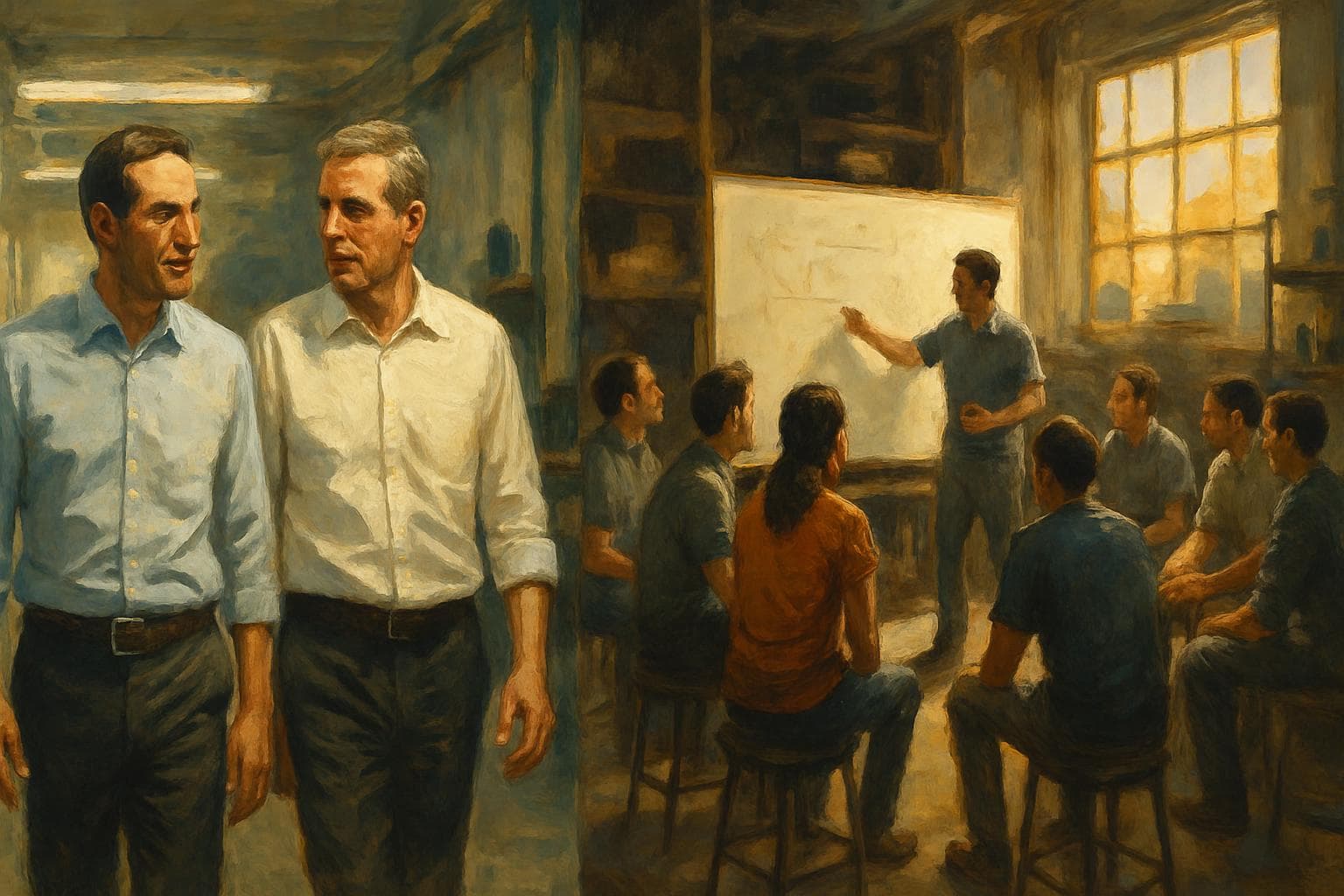
The phrase 'leading by example' has been so thoroughly drained of meaning by leadership posters that most working managers have stopped paying attention to it. Three twentieth-century companies — Hewlett-Packard, W. L. Gore & Associates, and the Brazilian conglomerate Semco — built unusually durable cultures of trust by treating leading by example not as a slogan but as the principal mechanism by which culture is actually transmitted. Each of the three did so in a different way, and each ran into the limits of the approach in instructive ways. Read together, they form the closest thing the modern era has produced to a controlled experiment on what leader behavior actually does.
Hewlett and Packard: The Floor as the Boardroom
Bill Hewlett and Dave Packard started their company in 1939 in a one-car garage in Palo Alto with $538 of working capital. By the mid-1960s HP employed tens of thousands of people across multiple continents and was the gold standard for engineering culture in American industry. The mechanism by which the founders maintained the culture, even as the company scaled, was unusually simple: they walked the floor.
The practice came to be called Management by Walking Around (MBWA), a term Tom Peters and Robert Waterman later borrowed for In Search of Excellence (1982). At HP it was less a technique than a habit. Both founders, every week of their working lives, walked through every facility they could reach, stopped at engineers' benches, asked what they were working on, and listened. They knew first names. They asked about the technical problem the engineer was actually facing, not the project as it had been described in the latest budget review.
The HP Way, the company's culture document, was written down — but the document was a description of behavior, not a prescription. Hewlett and Packard kept the open-door office, ate in the company cafeteria, refused executive parking, and answered their own phones for decades. Each of those decisions was, in Schein's terms, a signal: a daily, repeated demonstration of what was rewarded around here. No memo could have produced the same effect. The medium was the founders.
Gore: The Lattice Without Bosses
Bill Gore left DuPont in 1958 to start a company that, in his words, would not have managers. W. L. Gore & Associates — the company best known for inventing Gore-Tex — has, for sixty-plus years, run on a structure Gore called the lattice. Associates (never employees) commit to projects. Each project has a sponsor, not a boss; the sponsor coaches but does not direct. Compensation decisions are made by peer review. Promotions emerge from the willingness of others to follow you on a new project.
The mechanism that holds this system together, where it works, is the daily behavior of senior associates — particularly Bill Gore himself, who refused titles and refused offices, and ate lunch on the factory floor for the entirety of his tenure. New associates learn the culture by watching what the senior people do, because there is no formal hierarchy to read against. The entire company is in effect a long apprenticeship in a behavioral norm.
The limits of the model are real. Gore caps individual sites at roughly 200 people. Above that ceiling the lattice begins to fray; the company has to spawn a new building rather than grow the existing one. This is not a bug, in Gore's account; it is an admission that the leading-by-example mechanism has a bandwidth ceiling. You can scale a small culture by replicating the conditions, not by stretching them.
Semco: Trust as a Forcing Function
Ricardo Semler took over his father's industrial-equipment company in 1980 at age twenty-one and proceeded to dismantle nearly every piece of the conventional managerial apparatus. Workers set their own hours. Workers set their own pay. The company's books were opened to all employees, who took the time to learn financial statements because their compensation was tied to the company's results. Hiring decisions were made by peer interview, including for the candidate's prospective boss. Semler himself accepted, by his own design, no veto over salary decisions made by his subordinates.
Semler's books — Maverick (1993) and The Seven-Day Weekend (2003) — read in places like utopian propaganda, and the legend of Semco is more often cited than the reality is examined. But the underlying mechanism is the same as HP's and Gore's. Semler trusted the workforce visibly and consistently — published every salary, attended union meetings, walked the factory daily — and the workforce, after a multi-year adjustment period, repaid the trust with productivity gains and employee retention that the rest of Brazilian industry could not match. The culture was not policy. It was Semler's behavior, dosed daily, for thirty years.
Why Holacracy Failed
In the 2010s a software-industry framework called Holacracy attempted to systematize the flat-organization insight as a deployable methodology. Brian Robertson, its creator, published a constitution; companies adopted it. The most-cited adopter, Zappos, mandated company-wide adoption in 2013–2014. By 2020, most adopters had quietly walked Holacracy back, and Zappos itself moved to a hybrid model.
The failure mode is illustrative. Holacracy attempted to substitute a written framework for the daily behavior of a credible founder. The HP Way, the Gore lattice, and the Semco culture had not been imposed by a constitution. They had been made by the visible, repeated example of leaders willing to put their own decisions, their own pay, and their own status on the line. Holacracy tried to ship the artifact without the source. The frameworks worked in the original three companies because of the people, not despite them; transplanting the framework without the people produced confusion, not freedom.
Schein's Operational Definition
Edgar Schein's three-volume Organizational Culture and Leadership is the most rigorous modern treatment of the topic. Schein's central claim is that culture is what leaders pay attention to, measure, and reward — and, conversely, what they ignore, fail to measure, and decline to reward. The phrasing is operational. Culture is not values, not aspirations, not posters; it is the inferred answer to the question 'what does the leader actually do every day, and what happens when no one is looking?'
If this is right, then leading by example is not a soft virtue. It is the only mechanism culture has. Every meeting a leader attends, every email they answer, every decision they delegate or refuse to delegate, every promotion they sign off on, is information about what is actually rewarded. The team is constantly, unavoidably learning the rules from the leader's behavior. The cultures of trust HP, Gore, and Semco built were not built because the founders gave inspiring talks. They were built because the founders' Tuesday looked like the values the company claimed.
Modern hybrid descendants — Valve's flat-ish handbook, GitLab's all-remote rituals, Basecamp's calm-company manifesto — extend the experiment in different directions, with different failure modes. None of them invalidates the principle. If you want a culture of trust, the only durable mechanism is to be trustworthy in front of your team every day, in small repeated decisions, for years. There is no shortcut. There is no document. There is no consultant. There is only the manager's behavior, watched. Plan accordingly.
Sources
- 1.The HP Way · Wikipedia
- 2.Management by Walking Around (MBWA) · Wikipedia
- 3.W. L. Gore & Associates — lattice organization · Wikipedia
- 4.Ricardo Semler — Maverick · Wikipedia
- 5.Semco Partners · Wikipedia
- 6.Holacracy at Zappos — what happened · Wikipedia
- 7.Edgar Schein — Organizational Culture and Leadership · Wikipedia