
II — Ancient Roots (3000 BCE – 500 CE) · Chapter 10
Rome: The First Organization at Continental Scale
Legions, provinces, and the invention of middle management
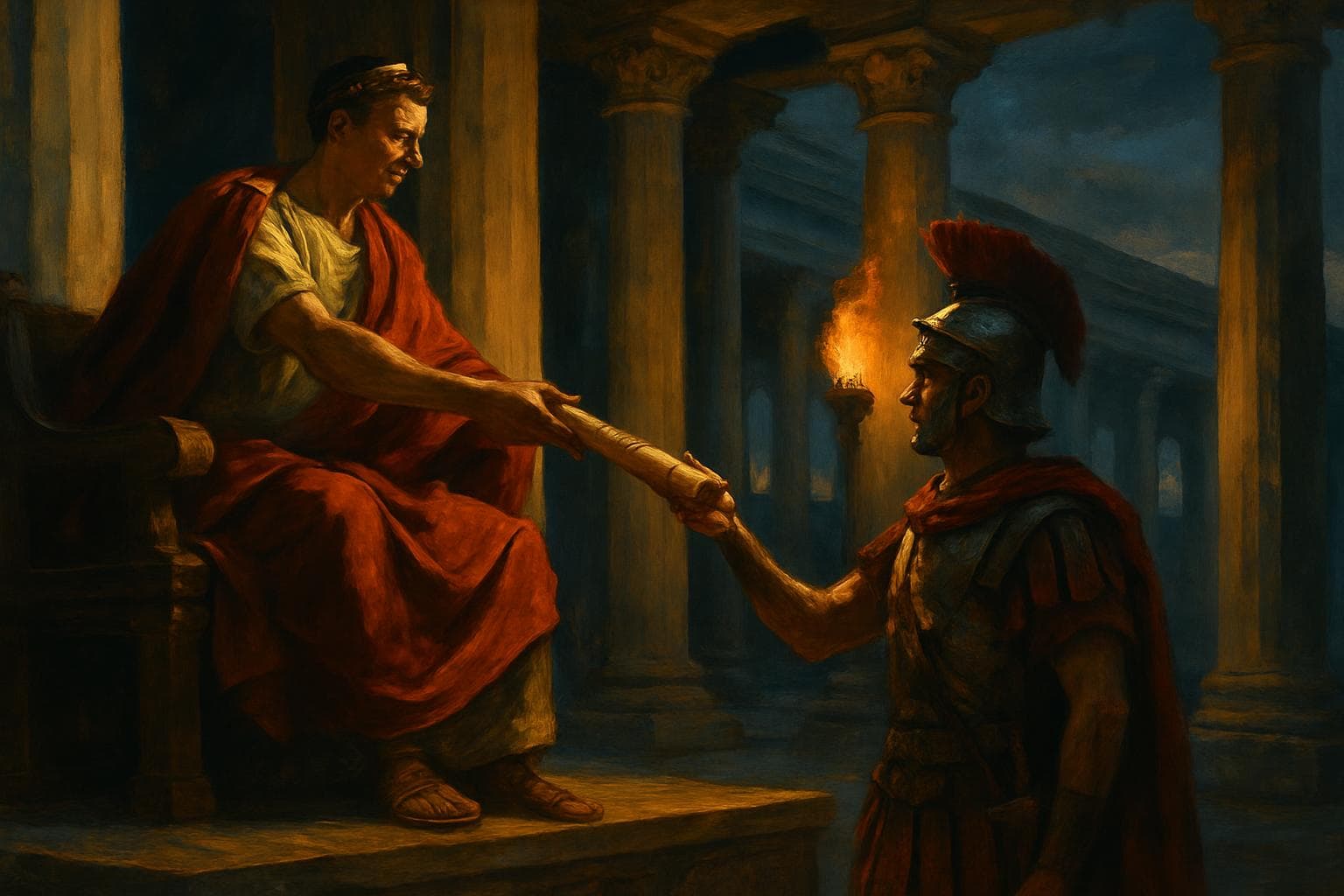
At its territorial peak around 117 CE, the Roman Empire administered roughly 60 million people across five million square kilometers, on three continents, in dozens of languages. There were no telephones, no telegraph, no airplanes, and no motorized transport. A letter from Rome to a provincial governor in Britain took roughly five weeks; a letter to the Egyptian frontier, three. Despite these constraints — or because of them — Rome ran the largest functioning organization in human history at that point. The mechanisms it invented to do so are recognizable even now. The legion, the provincial structure, the cursus honorum career path, and the provincial audit cycle were the first complete blueprint for management at continental scale.
The Legion as a Span-of-Control Solution
Roman military organization is the cleanest example we have of an empirical solution to the bandwidth problem of Chapter 2. A legion of roughly 4,800 to 5,200 fighting men was decomposed into ten cohorts, each of about 480 men. A cohort was decomposed into six centuries of about 80 men. A century was decomposed into ten contubernia of eight men who shared a tent. The smallest unit had a span of one — the contubernium had no commander, just a senior soldier. Each level above had a span ratio kept deliberately within human bandwidth.
The centurion sat at the structural fulcrum. He commanded eighty men by name, and was commanded in turn by a tribune who commanded ten centurions. The structure produced what the Romans called auctoritas — the centurion knew his men personally, the men knew the centurion personally, and the layer above could function because each tribune had only ten direct reports. This is, almost exactly, the span ratio Google's Project Oxygen rediscovered in the 2000s for high-judgment knowledge work. The technology of communication has changed beyond recognition. The bandwidth ceiling of the human manager has not.
The Provincial Structure
Rome divided its empire into provinces — administrative units of roughly 1 to 3 million people, headed by a governor (legatus or proconsul, depending on the province's status) appointed for a fixed term. The governor held imperium — civil, judicial, and military authority — over the province, but was bound by Roman law and accountable to the Senate or the emperor at the end of his term. The structural choice was deliberate. A province large enough to be economically meaningful was small enough that one governor could ride or sail across it in a few weeks. Provinces were further subdivided into civitates (city-territories) which retained substantial local self-government.
The genius of the system was that it required minimal central direction for routine matters. Provinces ran themselves on Roman legal forms with local elites in subordinate positions; central authority intervened only on military, fiscal, or major-judicial questions. Modern multinationals have rediscovered this structure several times, most explicitly in the 1990s when companies like Unilever and Nestlé federated their operations into regional and country units with substantial local autonomy. The Romans had the same insight without the management consultants. A continental organization survives only if most decisions are made locally.
The Cursus Honorum: A Mandatory Career Path
Roman politics under the Republic, and the imperial bureaucracy that succeeded it, organized senior careers around a structured progression called the cursus honorum — the 'course of offices.' A young Roman of senatorial class began with a military tribunate (typically in his early twenties), proceeded to junior magistracies (quaestor, then aedile), then to the praetorship in his late thirties, and only then could stand for the consulship in his forties. Each office had minimum age requirements, minimum tenure requirements between offices, and prerequisite offices that had to be held first.
The operational effect was twofold. First, no Roman senior official could rise to the top without having served, however briefly, at every level — military command, fiscal administration, judicial work, public-works oversight. Second, by the time a man held consular rank he had spent twenty years working alongside contemporaries who would later be his peers, his subordinates, and his superiors in different combinations. The system produced both broad competence and durable professional networks. Modern executive-development programs that rotate high-potential employees through finance, operations, sales, and engineering before considering them for senior leadership are working from a Roman template, often without knowing it.
The Provincial Audit Cycle
Roman provincial administration had a built-in audit mechanism that few subsequent empires matched in rigor. Provincial governors served fixed terms — typically one to three years — at the end of which their accounts and conduct were subject to review. Returning governors could be (and often were) prosecuted in Rome for misconduct in office, including extortion, bribery, and unauthorized warfare. The trial of Verres, the corrupt governor of Sicily, prosecuted by Cicero in 70 BCE, is the most famous example, but it was far from unique. The mechanism existed precisely because Rome's central authority could not directly supervise its governors during their tenure; the audit at the end was the principal disciplinary tool.
The analogy to modern internal audit and post-tour reviews is direct. The mechanism works only when the audit is taken seriously and when the prospect of prosecution is realistic enough to alter the official's behavior in real time. The Romans understood that the deterrent effect of the audit depended on the quality of the audit itself. When emperors began to shield favored officials from accountability — a slow drift that began under the late Republic and accelerated under bad emperors — provincial misgovernment grew correspondingly.
Why It Worked, and Why It Eventually Didn't
The Roman administrative system held together for several centuries because it respected the constraints of its era. Roads were built to make information travel faster. Provinces were sized to remain governable by a single human. Career paths were designed to produce broadly competent officials. Audits were designed to make corruption costly. None of these mechanisms was particularly clever; all of them were operationally rigorous.
The system began to fail when each of these disciplines decayed. Provinces were subdivided too small (under Diocletian) or held too long by the same governor (in the late empire). Career paths became hereditary rather than meritocratic. Audits became performative. The structural integrity of the organization was downstream of these disciplines, and when the disciplines slipped, the empire's coordination capacity slipped with them. The lesson for any modern continental organization is sober: the mechanisms that make scale possible are not natural; they are sustained only by deliberate, patient administrative work, and they will not survive their own neglect.
There is a reason the modern organizational chart looks the way it does. The Romans, with stone roads and wax tablets and no automation of any kind, solved the structural problems of running a continental enterprise — span of control, federation, career development, internal audit — and the solutions they reached are the same solutions every subsequent large organization has converged toward. They were not infallible, and the empire's eventual collapse contains its own management lessons. But the toolkit they assembled is older than most readers realize, and more relevant than the textbook caricature suggests.
Sources
- 1.Roman legion — organization · Wikipedia
- 2.Roman provinces · Wikipedia
- 3.Cursus honorum · Wikipedia
- 4.Trial of Gaius Verres · Wikipedia
- 5.Roman law — administrative basis · Wikipedia