
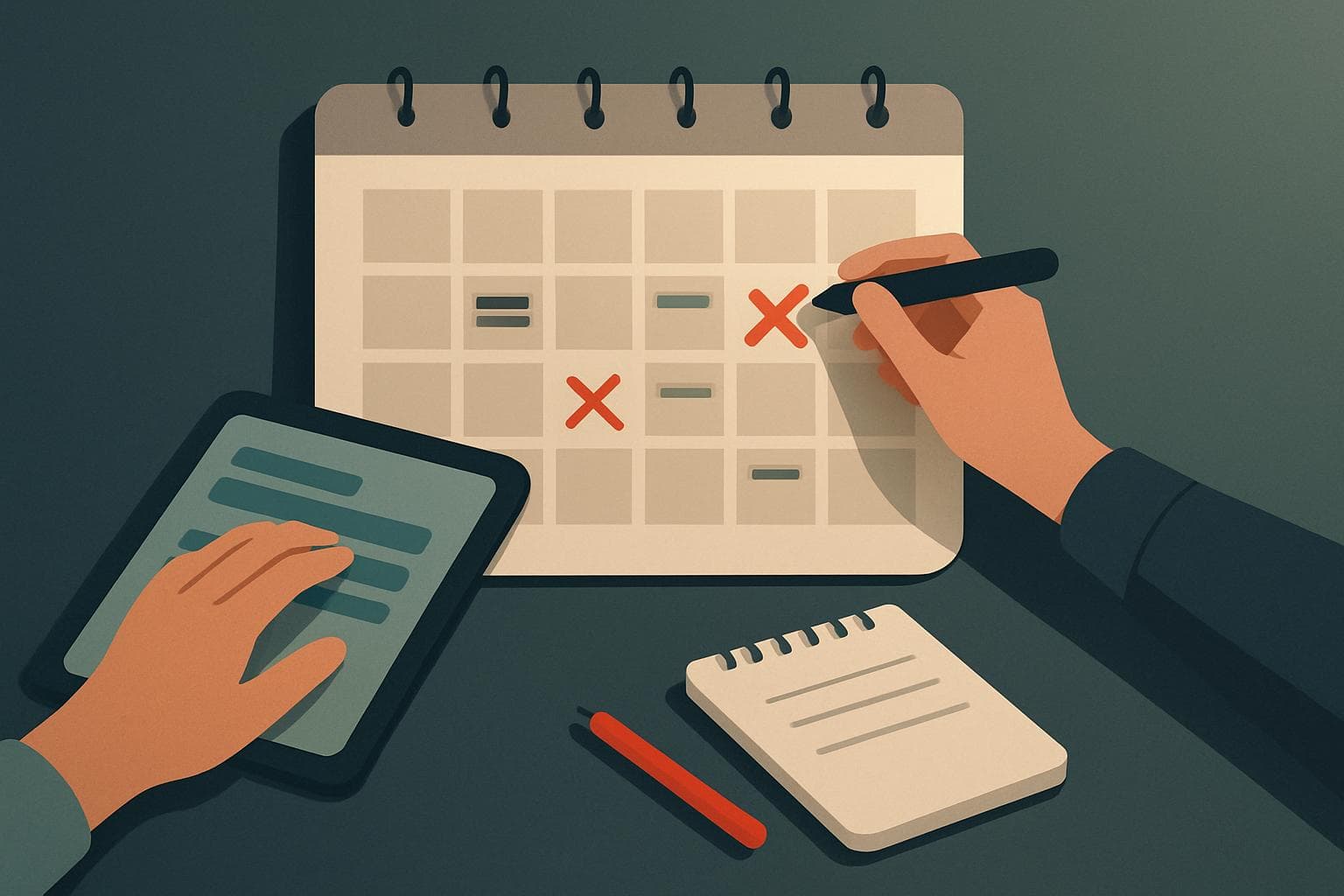
Here's an uncomfortable thing about annual goals: nobody ever misses them on purpose. They die in slow motion, one re-prioritized sprint at a time, and the moment of death is almost never December. It's right now — late June — when the year is exactly half over and most teams have never once stopped to compare where they are against where they said they'd be. The mid-year reset isn't a retreat or a fancy offsite. It's a 30-minute audit. And the teams that run it pull ahead in H2 while everyone else is still telling themselves Q3 will be the comeback quarter.
1. Do the Math You've Been Avoiding
Pull up your annual objectives and put a single number next to each one: percent complete. Not 'in progress.' Not 'on track.' An actual number. Half the year is gone, so anything under 50% is, mathematically, behind — and now you know it in June instead of finding out in November. Kavanah's portfolio view rolls this up automatically across every project, so the audit takes minutes, not a week of chasing leads for status.
2. Separate Behind From Dead
Some goals are behind because they're hard. Others are behind because the company quietly stopped caring in March and nobody said so out loud. Those are different problems. The reset forces you to name the zombie goals — the ones still on the slide deck but funded by nobody's actual time — and either revive them with real resourcing or kill them honestly. A goal nobody is working on isn't a goal. It's a guilt trip.
3. Re-Baseline H2, Don't Re-Hope It
The losing move is to keep the same plan and just hope the team moves faster. The winning move is to re-baseline: take what you actually shipped in H1 as your real velocity, and rebuild the H2 plan on that number instead of the optimistic one you invented in January. Kavanah estimates off real velocity, not vibes, so the second-half plan is built on what your team actually does — which means you'll hit it.
4. Surface the Silent Drift Before It Compounds
The goals you're about to miss are already sending signals — stalled tasks, deadlines that slid twice, threads that went quiet weeks ago. In most orgs those signals are scattered across five tools and nobody connects them until it's too late. Kavanah surfaces drift the moment it starts, so your mid-year reset isn't a forensic investigation. It's just reading the page that's already there.
5. Make It a Ritual, Not a Rescue
The teams that win aren't smarter — they just check the math on a schedule instead of in a panic. Run the reset at the end of June, again at the end of September, and the December surprise stops happening entirely. Boring? Yes. So is every habit that quietly outperforms everyone around you.
The first half of 2026 is gone whether you audit it or not. The only question is whether you find out where you stand now — with two quarters left to fix it — or in December, when all you can do is explain it.