
Kavanah

AI Agents

Auto-Planning

AI builds your sprint

Smart Triage

Auto-prioritize & assign

Agent Workflows

Automate any process

Risk Detection

Flag blockers early

Platform

Boards & Views

Kanban, timeline, list

Team Spaces

Shared project hubs

Team Chat

Communicate in context

Smart Alerts

AI-curated notifications

Learn

Blog

Tips and updates

Documentation

Guides and references

Support

Help Center

Get answers fast

Community

Connect with others

Pricing
Log inGet started

Business Plan

How Kavanah
Becomes a Category

A living document that captures what we’re building, who it’s for, how we’ll reach them, and what success looks like over the next 24 months.

Last updated · May 2026

Contents

  • 01Executive Summary
  • 02Problem
  • 03Solution
  • 04Market
  • 05Competition
  • 06Business Model
  • 07Go-to-Market
  • 08Traction
  • 09Milestones
  • 10Financials
  • 11Team
  • 12Risks & Mitigations
  • 13The Ask
Jump
$8.2BGlobal PM software market (2025)
13.5%Projected CAGR through 2030
AI-nativeBuilt around autonomous agents
$19–$49Per seat / month pricing

#01 · Executive Summary

An AI-native operating system for project work.

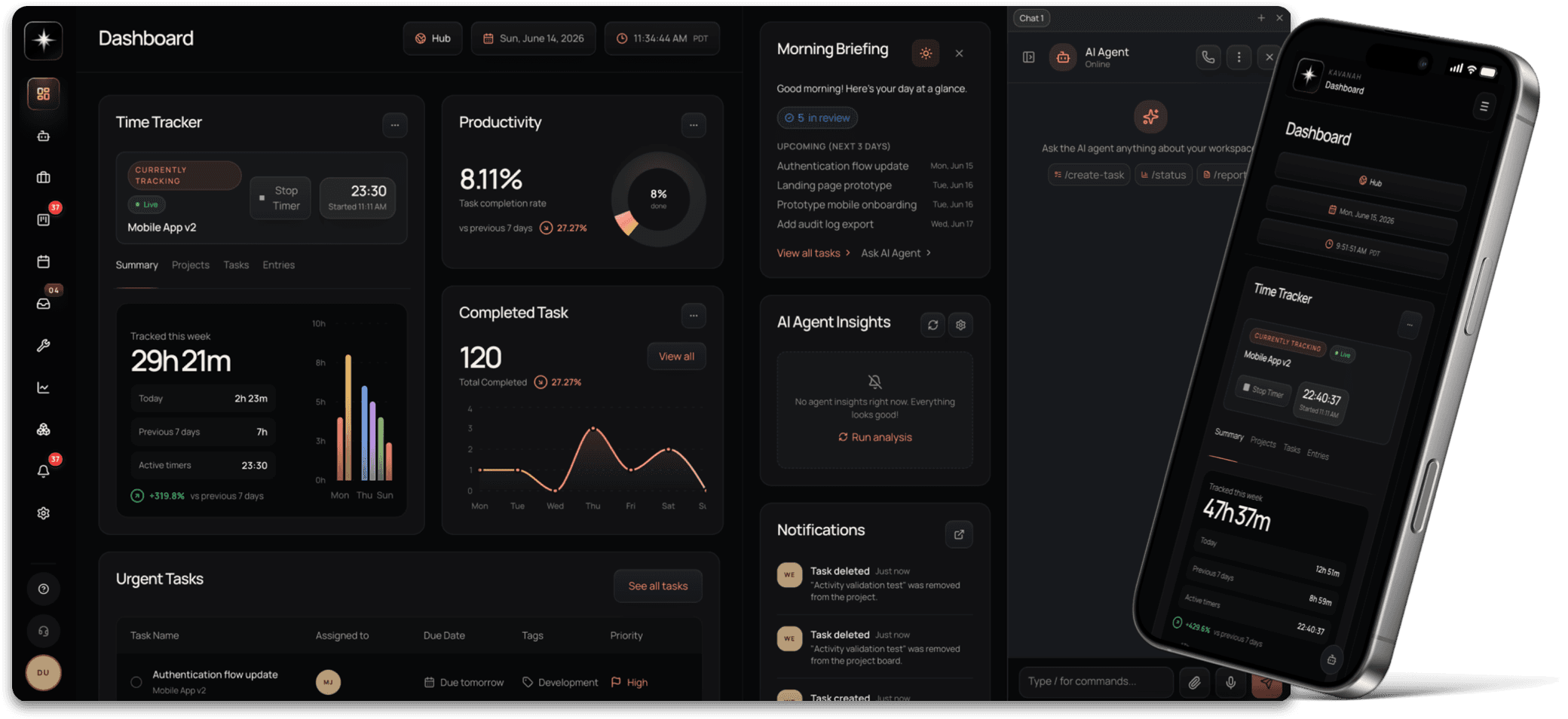
Kavanah is a unified project management platform built around autonomous AI agents. It replaces the patchwork of tasks, chat, time tracking, and client communication tools that modern service and product teams rely on, and turns the daily coordination overhead — status, triage, reporting — into something the software does on its own.

We monetise through a per-seat subscription with three published tiers, layered metered AI usage, and a marketplace for integrations and templates. The 24-month plan: convert a closed beta into a self-serve product with a measured outbound motion for the largest accounts, reaching $250K MRR with SOC 2 Type II by Q2 2027.

#02 · Problem

Coordination is the work no one was hired for.

Project management software has gotten broader, but not better. The daily friction is the same in 2026 as it was in 2016 — only now it\u2019s spread across more tabs.

Fragmented tools

Teams stitch together 5.2 tools on average — for tasks, chat, docs, time, and reporting — each with its own data model, billing, and learning curve.

Manual coordination tax

30% of a typical week disappears into status updates, triage, and reconciling plans rather than removing blockers.

Projects miss the mark

68% of projects ship over budget. Agencies and service teams default to email threads and screenshots, which erode trust and inflate scope creep.

#03 · Solution

One workspace. Real agents. A shared schema.

Kavanah is opinionated where it matters and open where it counts. Every primitive — task, project, message, time entry, client — sits in one canonical model that agents and integrations can act on.

Autonomous agents

Planning, triage, and reporting agents that read project context and act — drafting tasks, surfacing risk, writing weekly status.

Unified workspace

Tasks, projects, time, chat, discussions, docs, and a client portal in one canonical data model — no integrations to maintain.

Client-ready portal

Per-workspace branded portals with scoped permissions, so clients see exactly what you intend without exporting decks.

Open by default

OpenAPI 3.1 surface, webhooks, and a typed SDK so internal platform teams can extend Kavanah without waiting on us.

#04 · Market

A $15.5B market that’s ready for an opinionated re-platforming.

The global project management software market sits around $8.2B in 2025 and is projected to reach $15.5B by 2030 (~13.5% CAGR). AI is the most-cited buying driver in that growth — and incumbents are bolting it on, not designing for it.

TAM

$15.5B

PM software market by 2030

SAM

$2.4B

AI-native + agency-ready segment

SOM

$180M

Reachable in our first 24 months

10–80 seats

Boutique agencies

Design, dev, and consulting shops that bill clients and need a portal that doesn’t look bolted on.

20–250 seats

Series A–C startups

Fast-moving product teams that have outgrown spreadsheets but resent the ceremony of legacy PM suites.

Enterprise

Internal platform teams

Ops and IT functions that want a typed API to embed PM primitives into their own tooling.

#05 · Competition

Where we sit on the map.

The honest framing: there are great tools in this space. We\u2019re betting on a different shape — agent-native, schema-first, with a client surface as a first-class citizen.

PlayerPosture
Asana / MondayMature, broad — but bolt-on AI, slow surfaces, and per-feature upsells push real cost above headline pricing.
LinearBeloved by engineers — narrow scope (issue tracking), no client portal, no time billing, no agent layer.
Notion / ClickUpFlexible canvases — but flexibility is the cost: every team rebuilds the same primitives and AI is an afterthought.
KavanahOpinionated, agent-native, with a canonical schema across tasks, time, chat, and clients from day one.

#06 · Business Model

Three revenue lines, one engine.

Per-seat is the heart. Metered usage and the marketplace turn power users and ecosystem partners into expansion.

Per-seat SaaS

Three published tiers — Basic ($19), Pro ($49), Enterprise (custom). 30% discount on annual billing. Land on Pro, expand into Enterprise once SSO and custom integrations are required.

Agent usage

Metered AI credits sit on top of every plan. Heavy automation use (auto-triage, scheduled reports, agentic ticket drafts) bills in addition to seat fees, aligning revenue with realised value.

Marketplace & integrations

Revenue share on third-party integrations (CRM, billing, file storage) and a paid template marketplace for industry-specific playbooks.

Basic

$19

per user / mo

  • ✓Boards, tasks, and timelines
  • ✓Time tracking
  • ✓Team chat and discussions
  • ✓Email support

Pro

$49

per user / mo

  • ✓Everything in Basic
  • ✓AI planning and triage agents
  • ✓Client portal
  • ✓Priority support

Enterprise

Custom

custom pricing

  • ✓Everything in Pro
  • ✓SSO and advanced permissions
  • ✓Custom integrations
  • ✓Dedicated account manager

#07 · Go-to-Market

A staged motion: prove value, then widen the funnel.

Phase 1 — Design partner beta

42 hand-picked agencies and product teams. Free Pro for 6 months in exchange for usage telemetry, weekly feedback, and a public case study.

Phase 2 — Self-serve launch

Public sign-up with credit-card-required Pro trial. SEO around 'agency project management', 'client portal software', and 'AI project manager'. Founder-led content + Show HN / ProductHunt.

Phase 3 — Outbound + partners

Sales-assisted motion for Enterprise (SSO, audit, procurement). Channel partners with agencies-of-agencies and Vercel / Linear adjacent communities.

#08 · Traction

Early momentum, strong signal.

Closed beta numbers as of the last review cycle. Synced to the live pitch deck so investors and the team see the same picture.

1,200+Waitlist signups
42Beta teams
3.2xMoM growth
94%30-day retention

#09 · Milestones

The next four checkpoints.

Q2 2026

Public beta exits with 25 paying workspaces

Q3 2026

Agent platform GA + marketplace v1

Q4 2026

$50K MRR, SOC 2 Type I, first Enterprise logo

Q2 2027

$250K MRR, SOC 2 Type II, EU hosting

#10 · Financials

A capital-efficient path to default-alive.

Modelled bottoms-up against published pricing and conservative conversion assumptions. Numbers tighten as design-partner data lands.

Metric2026 (plan year)2027
Paying workspaces120650
Avg seats / workspace912
Blended ARPU / seat / mo$36$41
Ending MRR$50K$320K
Gross margin78%82%
Net burn / mo$110K$140K

Targets, not commitments. Assumes an 18-month runway from the forthcoming $2.5M seed round.

#11 · Team

Who\u2019s building it.

WS

William Schulz

Founder & CEO

Product + engineering lead. Sets direction, owns the agent stack.

MC

Maya Chen

Co-Founder & CTO

Infra, data model, and the OpenAPI surface everything ships on.

JE

Jordan Ellis

Head of Design

Owns the calm, opinionated interface — including the client portal.

PS

Priya Sharma

Head of Engineering

Scales the team and keeps shipping velocity high through GA.

#12 · Risks & Mitigations

What could go wrong, and what we\u2019ll do.

Incumbent AI catches up.

Keep moving on schema and agent orchestration — incumbents have to retrofit a 10-year data model. We don’t.

Agent reliability.

Every agent action is reversible, attributable, and gated by per-workspace policy. Trust beats novelty.

Per-seat compression.

Metered usage and marketplace revenue diversify away from raw seat count and align price with value.

Long enterprise cycles.

Self-serve PLG funds the company while a small Enterprise motion compounds in the background.

#13 · The Ask

$2.5M Seed round.

To accelerate product, expand the AI agent platform, and scale go-to-market into the AI-native PM category.

45%

Engineering & AI

25%

Go-to-Market

20%

Hiring

10%

Operations

Want a deeper look?

Live financial model, design-partner roster, and product roadmap available on request.

Pitch deckEmail the team